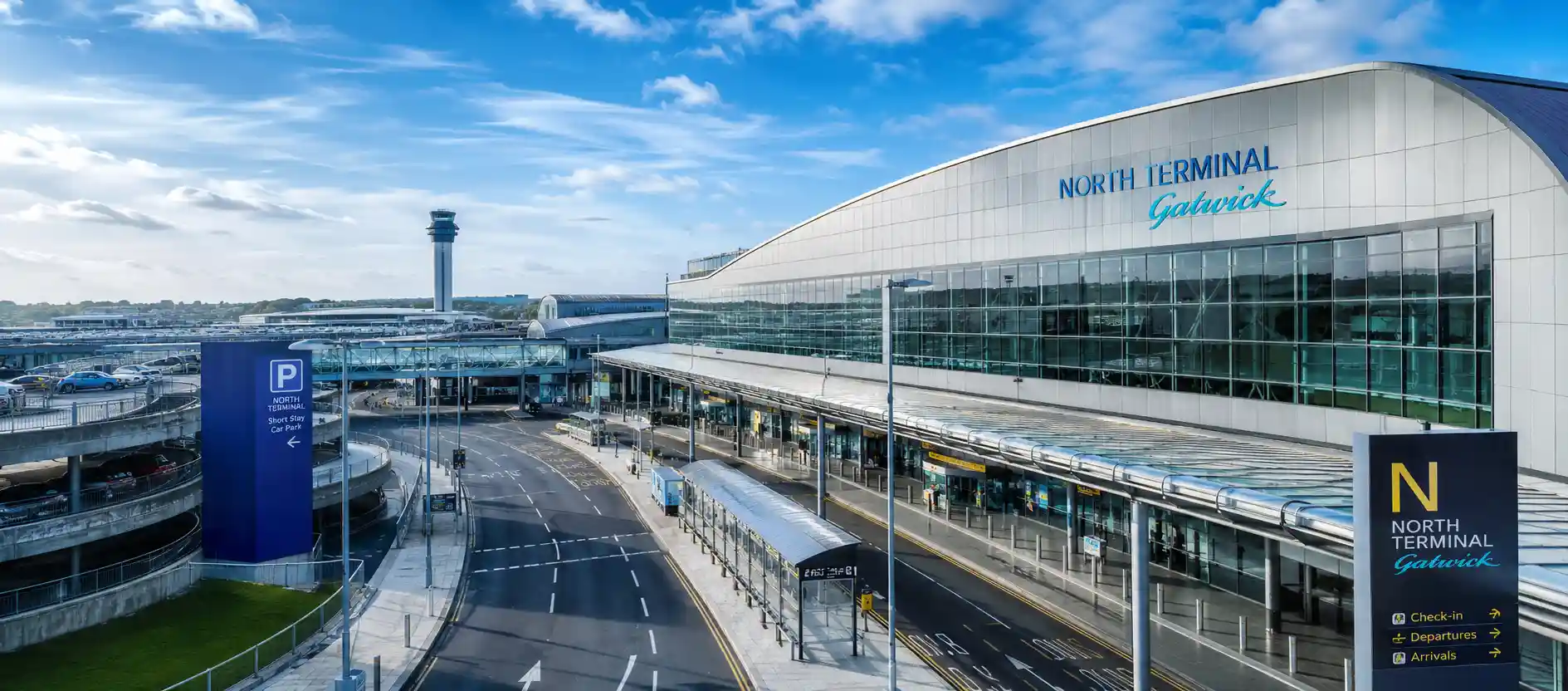
Gatwick North Terminal Map: Your Complete Navigation Guide
If you've searched for a gatwick north terminal map, you're probably trying to work out where check-in, security, your gate or the pick-up point actually are before you arrive. This guide breaks the terminal down floor by floor, using plain English rather than airport jargon. You'll find where departures, arrivals, shops and facilities sit in relation to each other, plus practical tips gathered from regular travellers who use the terminal often. By the end, you should be able to picture the layout clearly enough to move through it confidently, whether you're flying out, meeting someone, or planning a transfer.
.png) 2 Levels
2 Levels
.png) Departures & Arrivals
Departures & Arrivals
.png) 24/7 Operation
24/7 Operation
.png) Free Shuttle
Free Shuttle
What the Gatwick Airport North Terminal Map Actually Shows You
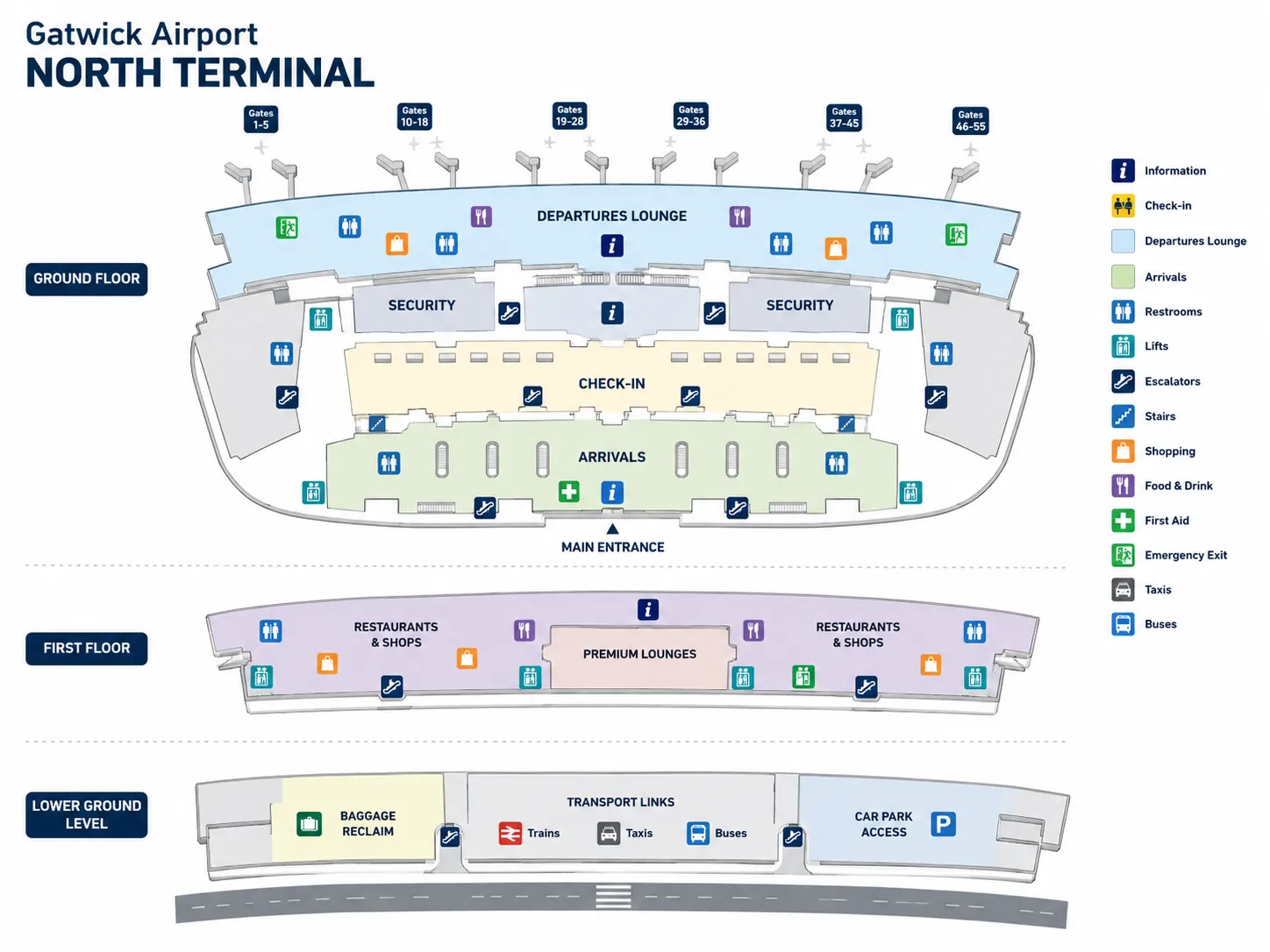
A typical gatwick airport north terminal map is arranged across two main levels: departures upstairs and arrivals downstairs. Departures covers the check-in area, security control, and the departure lounge with its shops and boarding gates. Arrivals sits below, handling baggage reclaim, customs and the exit into the main concourse where pick-ups happen. Understanding this two-level split is the single most useful thing you can take from any london gatwick north terminal map, because almost every question about "where is X" comes down to knowing which level you need.
-
Departures level: check-in desks, security control, departure lounge and boarding gates.
-
Arrivals level: baggage reclaim, customs, and the exit into the pick-up concourse.
-
Key entrance points: both levels are accessed from similar entrance points, but head upstairs for departures and downstairs for arrivals.
Quick fact
"If you're being dropped off to fly, head upstairs to departures. If you're collecting someone, wait near the arrivals hall on the lower level."
Gatwick Airport
North Terminal Map Guide
Reading a Map of Gatwick North Terminal: Departures Versus Arrivals
When people look at a map of gatwick north terminal for the first time, the two levels can feel confusing because both are accessed from similar entrance points. Departures level is where you go if you're catching a flight; it houses the departure hall, check-in desks and airline check-in counters. Arrivals level is for landing passengers and anyone collecting them. If you're being dropped off to fly, head upstairs. If you're collecting someone, you'll generally wait near the arrivals hall on the lower level, close to where relatives and drivers gather.
Departure Hall and Check-In Desks on the North Terminal Map
The departure hall is the first space you enter after arriving at the terminal, and it's the busiest part of any north terminal map gatwick travellers rely on. Rows of check-in desks are grouped by airline, with clear overhead signage showing which desks serve which carriers. Most airlines now offer self-service check-in kiosks alongside traditional desks, letting you print boarding passes and bag tags without queuing at a counter. Once you've checked in and dropped your bag, you'll head towards security control. If you're arriving by road, it's worth booking a reliable Gatwick Airport transfer in advance so you reach the departure hall with plenty of time before your flight, rather than rushing through check-in.
Security Control and the Departure Lounge Layout Explained
After bag drop, every passenger passes through security control before reaching the departure lounge. Expect the usual process: laptops and liquids out, pockets emptied, and a walk-through scanner. Queue times vary through the day, so building in extra buffer time is sensible, especially during school holidays. Once through, the departure lounge opens up into a wide retail and dining space before splitting off towards the boarding gates. Many passengers pre-book an airport transfer so their journey time to the terminal is predictable, leaving more of a buffer for security on busier days.
Boarding Gates and Gate Numbers on the North Terminal Map
Gate numbers at Gatwick North Terminal aren't usually confirmed until closer to departure, so keep an eye on the flight information screens dotted throughout the departure lounge. Once your gate is announced, walk time can range from a few minutes to considerably longer if you're allocated one of the satellite gates reached by an internal transit system. Any accurate gatwick map north terminal resource should flag this, because underestimating gate walk time is one of the most common reasons passengers miss boarding calls. Travellers heading to the airport by car often choose a standard taxi for a straightforward, no-fuss ride that gets them to check-in with time to spare.
Arrivals Hall and Arrivals Level Navigation Tips for Visitors
The arrivals hall sits on the lower level and is where landing passengers reappear after baggage reclaim and customs checks. If you're meeting someone, the arrivals level has a clearly marked waiting area near the exit doors, usually with screens showing recently landed flights. It's worth noting that international and some domestic arrivals can take 30–45 minutes from landing to appearing in the hall, depending on immigration queues and baggage handling. For a more comfortable wait and pick-up, some visitors arrange an executive taxi to collect arriving passengers directly, avoiding car park costs and long walks.
Shops, Food Court and Passenger Services Inside the Terminal
Beyond the practical layout, the terminal has a genuinely wide mix of shops, cafes and a food court positioned within the departure lounge, so you're not stuck eating airside sandwiches if you'd rather sit down properly before your flight. Passenger services desks are located near the departure hall and can help with lost property, special assistance requests, or general queries. Families travelling together, or larger groups heading to a wedding or event, often find it easier to book MPV cars in advance, keeping everyone and their luggage together in one vehicle rather than splitting across taxis.
Currency Exchange, ATMs and Airport Pharmacy Locations to Know
Currency exchange desks and ATMs are dotted through both the departure hall and the departure lounge, so you can withdraw cash before or after security depending on what you need. An airport pharmacy is also available airside, useful for last-minute travel essentials, medication top-ups or basic toiletries you've forgotten to pack. If you're travelling as a larger family or group and need transport that comfortably fits everyone plus shopping and luggage, a minibus booked ahead of time removes the stress of coordinating multiple cars.
Charging Points, Wi-Fi and Staying Connected Airside at Gatwick
Free Wi-Fi is available throughout the terminal, and charging points are built into seating areas near gates and in the main departure lounge, though they can get busy at peak times. It's a good habit to charge devices fully before leaving home rather than relying solely on airport sockets. For a stress-free start to your journey, many regular flyers rely on established taxi services that track flight times and adjust pick-up slots automatically if your schedule changes.
How to Move Between Gatwick North Terminal and South Terminal
North Terminal and South Terminal are connected by a free monorail-style shuttle called the Gatwick Inter-Terminal Transit, running every few minutes and taking around two to three minutes to cross. This matters if you've landed at one terminal but need a connecting flight from the other, or if you've booked a hotel or pick-up near the wrong terminal by mistake. For a full breakdown of timings and platform locations, our inter-terminal shuttle guide covers everything you need to know before you travel.
Where to Be Picked Up at Gatwick North Terminal After Landing
The official pick-up point for pre-booked cars at North Terminal is a short walk from the arrivals exit, clearly signposted from the terminal building. Free waiting isn't offered in the closest zones, so most drivers wait nearby and time their arrival to match your flight landing. For step-by-step directions, exact meeting points and driver instructions, see our dedicated North Terminal pick-up guide, which covers the process in full.
Where to Be Picked Up at Gatwick South Terminal for Comparison
If your flight actually lands or departs from South Terminal instead, the pick-up arrangements differ slightly in layout, though the general principle is the same. Knowing the difference matters because North and South Terminal buildings are not within easy walking distance of each other without using the free shuttle. Our South Terminal pick-up guide explains the exact meeting points so you don't end up waiting at the wrong building.
Best Drop-Off Points at Gatwick North Terminal Explained Clearly
For drop-offs, the North Terminal has a designated set-down area directly outside departures, allowing a quick stop to unload luggage before heading through check-in. Charges apply for the closest drop-off zones, and stopping in the wrong lane can lead to a fine, so it's worth knowing the layout beforehand. Full details, including current charges and the quickest routes in, are covered in our North Terminal drop-off guide.
Comparing Drop-Off Options at Gatwick South Terminal Nearby
South Terminal's drop-off area follows a similar set-down system but sits in a different location entirely, so it's not something you can improvise if you're unfamiliar with the airport. Mixing up the two terminals at the drop-off stage is a common and entirely avoidable mistake. Our South Terminal drop-off guide lays out exactly where to stop, depending on which terminal your flight uses.
Common Mistakes Passengers Make When Using the Terminal Map
The most frequent error is confusing North and South Terminal entirely, particularly for passengers flying with airlines that have moved terminals in recent years. Always check your boarding pass or airline confirmation rather than assuming. Other common mistakes include underestimating gate walk times, arriving at the wrong drop-off zone, and forgetting that arrivals and departures sit on completely different levels. Double-checking your terminal the night before travel takes thirty seconds and avoids real stress on the day.
Quick Checklist Before You Travel to North Terminal
- Confirm your terminal on your booking confirmation, not just from memory.
- Check in online where possible to reduce desk queuing time.
- Allow extra time for security control during school holidays.
- Note your gate only once it's confirmed on the screens, not before.
- Charge devices before you leave home rather than relying on airport points.
Accessibility and Special Assistance Across the North Terminal
Passengers needing special assistance can request support in advance through their airline, with dedicated help points located near the departure hall and arrivals level. Lifts and step-free routes connect all major areas of the terminal, including access to the inter-terminal shuttle. Booking assistance ahead of travel, rather than on arrival, generally means a smoother and quicker experience through each stage of the terminal.
Frequently Asked Questions About the Gatwick North Terminal Map
Is the gatwick north terminal map the same for departures and arrivals?
No. Departures and arrivals sit on separate levels within the same building, so a single map usually shows both, but the routes through each are entirely separate.
How do I find a map of gatwick airport north terminal before I travel?
The official Gatwick Airport website publishes a downloadable and interactive terminal map, and printed versions are also displayed throughout the building near key junctions.
Where are the check-in desks shown on the north terminal gatwick map?
Check-in desks are on the upper departures level, directly through the main entrance, grouped by airline with overhead signage confirming desk numbers.
How long does it take to walk from check-in to the boarding gates?
Allow at least 20–30 minutes from bag drop to gate, longer if you're allocated a satellite gate reached via the internal transit system.
Does the gatwick north terminal departures map show gate numbers in advance?
Gate numbers are usually confirmed shortly before boarding on the flight information screens, rather than being fixed permanently on printed maps.
Can I get from North Terminal to South Terminal on foot?
No. The terminals aren't connected by a walkable route for passengers; the free inter-terminal shuttle is the only way to move between them airside and landside.
Where is the food court located on the departures level?
The food court sits within the departure lounge, past security control, offering a mix of cafes and restaurants before you reach the gates.
Is there an airport pharmacy in North Terminal?
Yes, an airport pharmacy is available airside within the departure lounge, stocking medication, toiletries and basic travel essentials.
Where can I exchange currency at North Terminal?
Currency exchange desks are located both before and after security control, so you can choose whichever suits your journey timing.
What happens if I go to the wrong terminal?
You'll need to use the free inter-terminal shuttle to reach the correct building, which takes a few minutes, but it does add time, so always confirm your terminal beforehand.
Are there charging points throughout the departure lounge?
Yes, charging points are built into most seating areas, though availability can be limited during busy periods.
Where do I wait if I'm picking someone up from arrivals?
A dedicated waiting area sits just outside the arrivals hall exit, with screens displaying recently landed flights to help you time your arrival.
Is Wi-Fi free throughout the terminal?
Yes, free Wi-Fi is available across both departures and arrivals areas of the terminal.
How early should I arrive before checking a map of gatwick north terminal for the first time?
For a first visit, arriving two to three hours before a short-haul flight gives enough buffer to navigate check-in, security and the walk to your gate without rushing.
Do I need to pay to drop someone off at North Terminal?
Yes, the closest set-down zones charge a fee, though a short free drop-off period may apply further from the terminal entrance depending on current airport policy.