Gatwick Inter Terminal Shuttle: Complete Free Transfer Guide
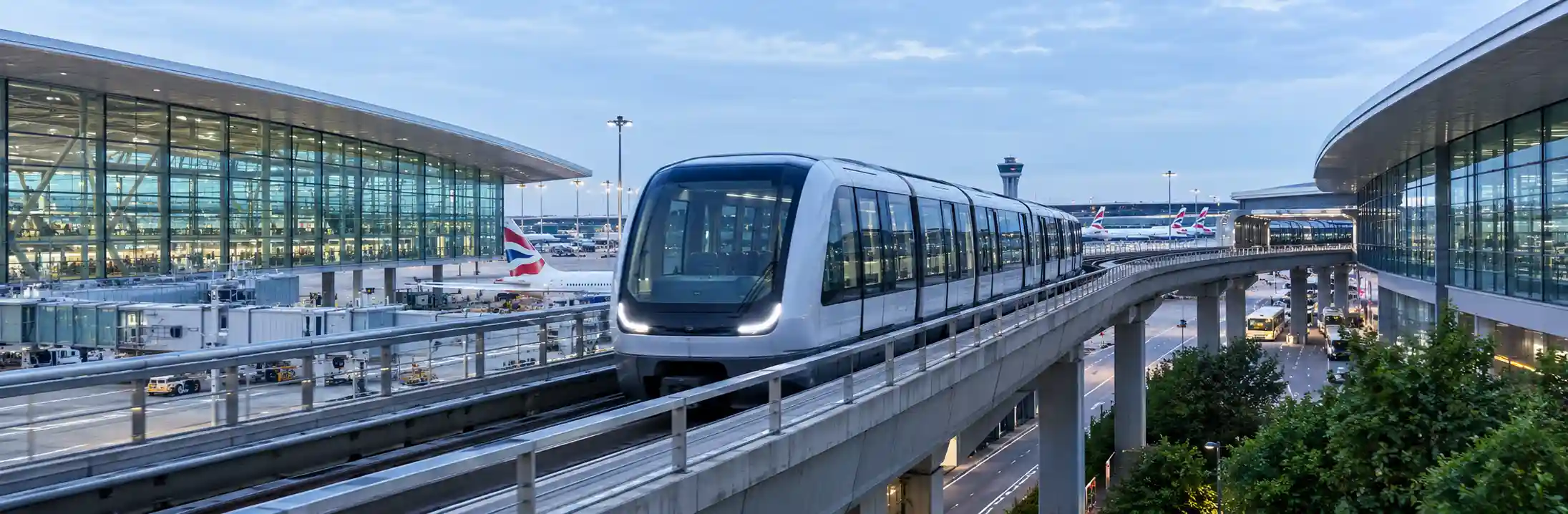
The Gatwick inter terminal shuttle is a free, driverless train that links Gatwick's North and South Terminals in about two minutes. It runs every few minutes, 24 hours a day, every day of the year. No ticket, booking or fee is needed. Anyone can use it — departing passengers, arriving passengers, meeters and greeters, and staff. This guide explains exactly how the Gatwick inter terminal shuttle works, where to find the platforms, how long to allow, and what to do if it is closed for maintenance. You will also find timings, luggage rules, accessibility details, alternatives and the mistakes that catch travellers out. By the end, you will be able to plan your Gatwick airport terminal transfer with total confidence.
The Gatwick inter terminal shuttle is an automated people mover — an airport transit system that carries passengers along a raised guideway between the two terminal buildings. There is no driver on board. The trains are computer-controlled, which is why they can run so frequently and so late at night.
.png) Free Service
Free Service
.png) 24/7 Operation
24/7 Operation
.png) 2-Minute Ride
2-Minute Ride
.png) Step-Free Access
Step-Free Access
What The Gatwick Inter Terminal Shuttle Is And How It Operates
The Gatwick inter terminal shuttle is an automated people mover — an airport transit system that carries passengers along a raised guideway between the two terminal buildings. There is no driver on board. The trains are computer-controlled, which is why they can run so frequently and so late at night.
-
Landside, not airside: you are in the public part of the airport while you travel, and you will need to clear security again in the terminal you arrive at.
-
Open to everyone: you do not need a boarding pass, a ticket or a booking reference to ride it.
-
Gatwick's North and South Terminals sit on opposite sides of the airfield, roughly 1.2 km apart. There is no public footpath between them.
Quick fact
"The shuttle has been in service since 1987 and has been upgraded several times since."
Shuttle service
Free · 24h · Every few minutes
Quick facts about the Gatwick terminal shuttle
Here are the essential details for the Gatwick inter-terminal shuttle at a glance, covering everything from journey time and cost to operating hours and accessibility, so you know exactly what to expect before you travel.
| Feature | Detail |
|---|---|
| Type | Automated people mover / shuttle train |
| Route | North Terminal ↔ South Terminal |
| Cost | Free — no ticket required |
| Journey time | About 2 minutes |
| Frequency | Every few minutes |
| Hours | 24 hours, 365 days a year |
| Access | Landside, step-free, open to all |
| Booking | Not needed and not possible |
Gatwick Shuttle Train Timings, Frequency And 24-Hour Running
The Gatwick shuttle train runs 24 hours a day, every day of the year, including Christmas Day. There is no published timetable to memorise because services depart continuously rather than at fixed clock times.
In practice, waiting time is short. Trains arrive every few minutes, and even at 3am you rarely stand on the platform for long. The ride itself takes roughly two minutes, but the ride is only part of the journey. Walking to the platform, waiting, and walking out at the other end all add time.
| Situation | Realistic time to allow |
|---|---|
| Ride only, platform to platform | 2–3 minutes |
| Concourse to concourse, no bags | 10 minutes |
| Concourse to concourse with luggage | 15 minutes |
| Peak morning or school holidays | 15–20 minutes |
| Connecting flight, different terminal | 90 minutes minimum |
A sensible rule: budget 15 minutes door to door. If you land at the wrong terminal with two suitcases and a pushchair, 20 minutes is safer. The inter terminal shuttle service Gatwick runs is fast, but the walk through a busy concourse is not always quick.
How To Find The Inter Terminal Shuttle Gatwick Stations Fast
Follow the overhead signs for the terminal you want, not for the word "shuttle" alone. Gatwick signposts the route as "North Terminal" or "South Terminal", with a small train symbol. Once you are on the correct trail, the signage is continuous and hard to lose.
In the South Terminal, the shuttle station sits at the end of the main concourse, close to the railway station and the arrivals area. Lifts and escalators take you up to the platform level.
In the North Terminal, the shuttle station is reached from the main concourse near check-in and arrivals, again by lift or escalator. Both stations have level boarding, so wheels roll straight on.
If you have booked ground transport in advance, remember that pickup points are terminal-specific. Drivers meeting you at Gatwick Airport taxi service points will be waiting in the terminal named on your booking, so it is worth confirming which side of the airport you will actually walk out of before you travel.
Your Step By Step Guide To Riding The Gatwick Terminal Shuttle
Using the Gatwick inter terminal shuttle takes five simple steps.
- Confirm your terminal. Check your boarding pass or the departure boards. Airlines occasionally move between terminals, so a past trip is not proof.
- Follow the signs. Head for the shuttle station signposted with the name of your destination terminal.
- Go up to the platform. Use the lift if you have bags, a pushchair or limited mobility.
- Board and hold on. There are handrails, poles and some seating. Stand clear of the doors and keep bags close to you.
- Exit and re-orient. Follow signs for check-in, departures, arrivals or the exit, depending on why you crossed.
There is nothing to tap, scan or pay. If you are arriving into the UK and someone is collecting you, agree the meeting terminal before you fly rather than after you land. A pre-booked airport transfer service works best when both driver and passenger are certain which terminal the pickup will happen at.
Connecting Flights And The Gatwick Transfer Between Terminals
If your connecting flight departs from the other terminal, allow at least 90 minutes between landing and your next departure. Gatwick advises this minimum, and individual airlines may require more. Always check your airline's minimum connection time before booking a self-transfer.
Why so long for a two-minute train ride? Because a Gatwick transfer between terminals is a landside move. Depending on your itinerary, you may need to:
- clear passport control or immigration
- collect checked luggage from baggage reclaim
- ride the shuttle to the other terminal
- check in and drop your bags again
- pass through security screening a second time
Passengers on a single through-ticket with bags checked to the final destination have an easier time, but the walk, the shuttle and the second security queue still apply. Self-connecting on separate tickets carries the most risk: if the first flight is late, no airline is responsible for the missed second one.
If a connection does collapse and you need an overnight stay nearby, a pre-booked standard taxi to a local hotel is usually cheaper and quicker to arrange than joining a long rank queue at midnight.
Arriving At The Wrong Gatwick Terminal: What To Do Next Fast
If you arrive at the wrong terminal, do not panic — walk to the shuttle. Landing at the wrong side of Gatwick costs you around 15 minutes, not your flight, provided you notice early.
The common causes are simple: a taxi dropped at the wrong door, a train that only stops at the South Terminal, an airline that switched terminals since your last trip, or a booking made for the wrong airport building entirely.
Act in this order. Check the departure screens to confirm your true terminal. Head straight for the Gatwick airport inter terminal shuttle rather than looking for a bus or taxi. If you have already dropped a bag, speak to airline staff immediately — bags cannot follow you across the airfield on their own.
One important detail: the railway station serves the South Terminal only. Rail passengers heading for a North Terminal flight must ride the shuttle after leaving the train. Travellers who dislike that extra leg at 4am often prefer a door-to-door executive taxi that drops them at the correct terminal kerb first time.
Luggage, Trolleys And Accessibility On The Gatwick Shuttle Train
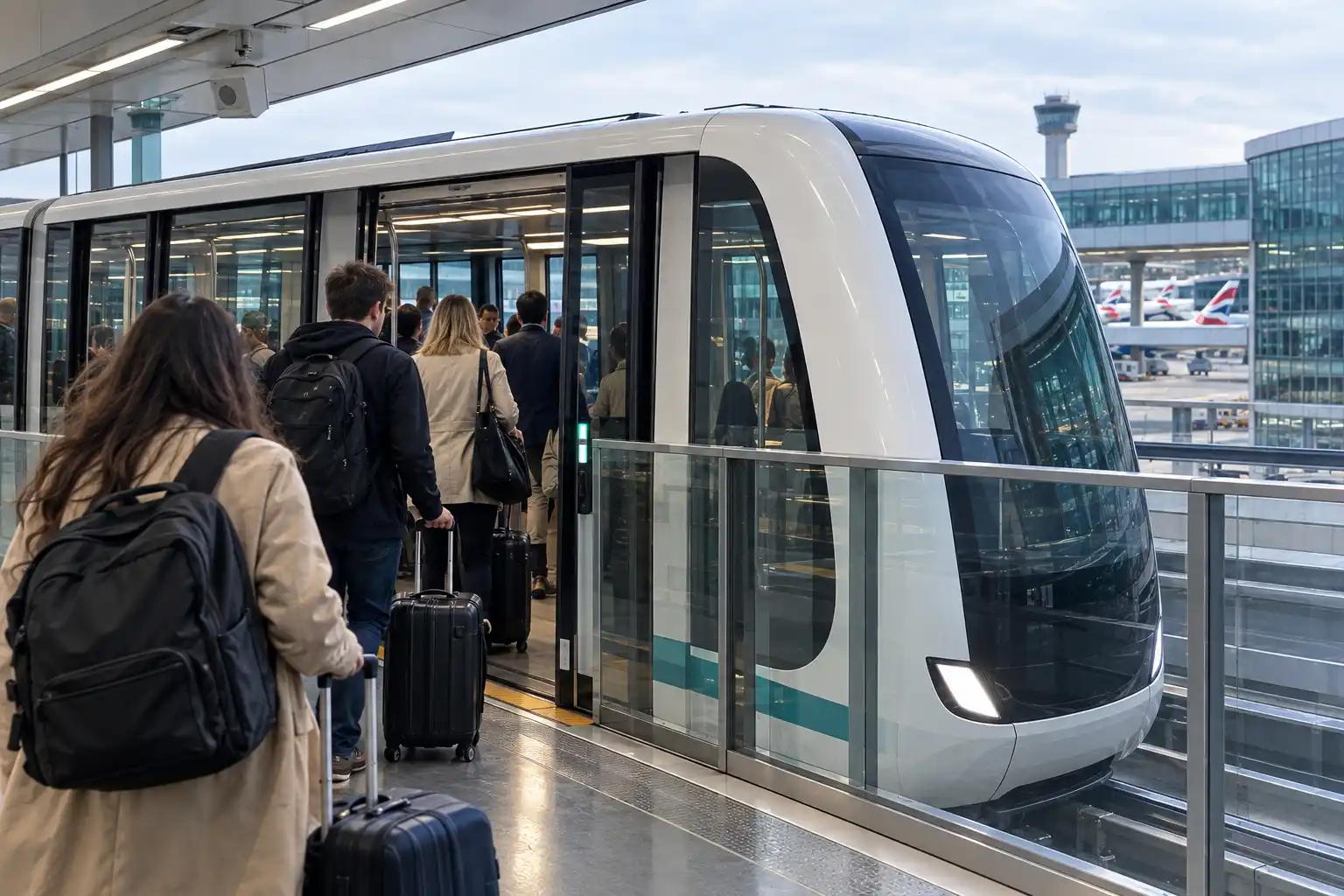
There is no luggage limit on the shuttle and no size restriction on suitcases. You keep your bags with you throughout the two-minute ride, and there are open standing areas designed for cases, rucksacks and pushchairs.
Trolley bays are provided at the station entrances. Check the signage before you go up to the platform, as trolley access is restricted in some areas and it is often easier to collect a fresh trolley on the other side.
Accessibility is a strong point of the Gatwick airport shuttle train. Both stations offer step-free access by lift, boarding is level with the platform, and carriages have space for wheelchairs and mobility scooters. Passengers who need help should book Special Assistance with their airline at least 48 hours before flying; assistance staff can escort you across the shuttle rather than leaving you to navigate alone.
Families and travellers with unusual loads sometimes hit a limit — golf bags, ski gear, musical instruments or four large cases plus a buggy. The shuttle will carry them, but the walk either side is the hard part, which is why many travellers book MPV cars with proper boot space for the onward leg.
Travelling With Children, Large Groups And Elderly Passengers
The shuttle is easy with children, but it is busy, brief and full of moving people. A few habits make it painless.
Practical advice for families
Keep pushchairs assembled — you do not need to fold them. Hold small children's hands while boarding, because the doors close on a timer. Stand back from the platform edge and let the crowd move first if you are not in a rush.
Advice for older or slower-moving travellers
Use the lift rather than the escalator with luggage. Aim for a seat if one is free, and take the following train if a carriage looks packed. Nothing is gained by squeezing on when another arrives within minutes.
Advice for large groups
Groups of ten or more should agree a meeting point at the destination station before boarding, as the group will naturally split across two or three trains. Sports teams, tour groups and wedding parties often find the onward journey harder than the shuttle itself; a single minibus hire keeps everyone and their luggage together instead of splitting across several cars.
What Happens When The Gatwick Airport Shuttle Train Stops Running
When the shuttle is closed, Gatwick runs a free replacement bus between the two terminals. Signs and airport staff direct passengers to temporary pickup points, usually near the forecourts on the arrivals side of each terminal.
Closures happen for three reasons: planned overnight engineering, unplanned technical faults, and occasional major maintenance programmes that take one track out of service for a longer period. During a partial closure the service still runs, just less frequently.
The practical impact is time. A replacement bus follows the road network around the airport, so allow 20 to 30 minutes rather than 15. If you are already tight for a flight, that difference matters.
Check the airport's live travel updates on the morning you fly, especially for very early or very late departures. Families landing at 1am who would rather not wait for a replacement bus with tired children sometimes book a 6 seater taxi straight from the terminal instead.
The Best Alternative Ways To Move Between Gatwick's Two Terminals
The shuttle is the fastest and cheapest option, but it is not the only one. Knowing the alternatives helps when the service is disrupted or when your journey does not actually start or end inside the airport.
| Option | Time | Cost | Best for |
|---|---|---|---|
| Inter terminal shuttle | 2 minutes | Free | Almost everyone |
| Free replacement bus | 20–30 minutes | Free | When the shuttle is closed |
| Taxi or private hire | 10–15 minutes | Paid | Heavy luggage, mobility needs |
| Walking | Not available | — | No public footpath exists |
| Local bus route | Varies | Paid | Continuing beyond the airport |
Walking deserves a clear warning. There is no signposted pedestrian route between North and South Terminals, and the road between them is not designed for people on foot with suitcases. Do not attempt it.
Paying for a vehicle only makes sense in specific cases: a passenger who cannot manage lifts and concourses, an overnight airport hotel on the far side, or a group with a mountain of bags. In those situations a 7 seater taxi can cover the whole journey in one trip rather than two shuttle runs.
Common Mistakes Travellers Make With Gatwick Terminal Transfers
Most Gatwick transfer problems are planning errors, not transport failures. These are the ones that cost people the most time.
- Assuming your terminal has not changed. Airlines move between North and South. Check the boarding pass, not your memory.
- Treating the shuttle as airside. You will queue for security again after crossing.
- Booking a 60-minute connection. Ninety minutes is the sensible floor for a terminal change.
- Forgetting the railway station is South Terminal only. North Terminal rail passengers must add the shuttle leg.
- Sending a driver or family member to the wrong terminal. Confirm the pickup terminal in writing.
- Parking in the wrong car park. North and South have separate car parks with separate bus links.
- Ignoring overnight engineering notices. Late arrivals are the most likely to meet a replacement bus.
- Underestimating group luggage. Four adults with hold bags rarely fit a saloon car; an 8 seater taxi avoids a second vehicle and a second fare.
Expert Tips For A Smoother Gatwick Airport Terminal Transfer
These small habits come from experience rather than airport brochures, and they consistently save time.
- Screenshot your terminal name before you leave home, so you are not hunting for it on airport Wi-Fi.
- Stand near the middle doors — they clear faster than the ends at busy times.
- If you land after midnight, assume the airport is quieter but the walks feel longer. Add ten minutes.
- Do a bag count out loud before boarding and after alighting. Two minutes is long enough to leave a rucksack behind.
- Use the lifts if you are carrying anything with wheels. Escalators with suitcases are the main cause of minor airport injuries.
- If you are meeting someone, choose an obvious fixed landmark in the terminal rather than "by the shuttle".
- Rail travellers heading to the North Terminal should build the shuttle into their train choice, not into their spare time.
Finally, decide early whether you actually want to use the shuttle at all. If your journey starts in London, Surrey or Sussex, arranging door-to-door taxi services to the correct terminal removes the transfer question entirely, which is particularly useful for early-morning departures and passengers with reduced mobility.
Gatwick Inter Terminal Shuttle Questions Travellers Often Ask
Is the Gatwick inter terminal shuttle free?
Yes. The Gatwick inter terminal shuttle is completely free. There is no ticket, no barrier and no fare, and it is free for every passenger, visitor and member of staff.
How long does the inter terminal shuttle Gatwick service take?
The ride takes about two minutes. Allow 10 to 15 minutes in total once you include walking to the platform, waiting and walking out at the other end.
Does the Gatwick airport shuttle train run all night?
Yes. It operates 24 hours a day, 365 days a year, apart from occasional planned engineering work when a free replacement bus runs instead.
Can I walk between Gatwick North and South Terminals?
No. There is no public pedestrian route between the terminals. Use the shuttle or, if it is closed, the free replacement bus.
Do I need to go through security again after the transfer?
Yes. The shuttle runs landside, so you must pass through security screening again in the terminal you arrive at.
How much time should I allow for a connecting flight in the other terminal?
Allow at least 90 minutes. Your airline may require longer, so check its minimum connection time before booking.
Where is the shuttle station in each terminal?
In the South Terminal it is at the end of the main concourse near the railway station. In the North Terminal it is reached from the main concourse by lift or escalator. Follow signs for your destination terminal.
Is the Gatwick shuttle train wheelchair accessible?
Yes. Both stations have step-free lift access, boarding is level, and carriages have dedicated space for wheelchairs and scooters. Book Special Assistance through your airline at least 48 hours ahead for extra support.
Can I take luggage trolleys onto the shuttle?
Trolley bays are provided at the stations and trolley access is restricted in places. Check the signage on the day and collect a fresh trolley at the other end if needed.
Do I need to book the inter terminal shuttle service Gatwick operates?
No. Booking is not required and not possible. Simply turn up at the platform and board the next train.
Which terminal has the Gatwick railway station?
The South Terminal. Passengers travelling to the North Terminal by train must take the shuttle after arriving, so add 15 minutes to your plan.
What happens if the Gatwick inter terminal shuttle is closed?
A free replacement bus service runs between the terminals, following signs from the arrivals forecourts. Allow 20 to 30 minutes instead of 15.
Can I use the shuttle if I am not flying that day?
Yes. The shuttle is open to the public, including people collecting arrivals, hotel guests and airport visitors. No boarding pass is needed.
Is a taxi ever better than the Gatwick airport inter terminal shuttle?
Rarely for the transfer itself, since the shuttle is faster and free. A taxi makes more sense for groups with heavy luggage, passengers with mobility difficulties, or anyone continuing to a hotel or address beyond the airport.
Can I take a bicycle or pet on the shuttle?
Assistance dogs travel with their owners. For bicycles, pet carriers and other bulky items, check with airport staff on arrival, as rules can change with crowding levels.
What if I dropped my bag and then discovered the wrong terminal?
Speak to your airline's staff immediately rather than crossing on your own. Checked baggage cannot be transferred between terminals by passengers.
Final Words
Used sensibly, the Gatwick inter terminal shuttle turns what looks like a major problem — being on the wrong side of a large international airport — into a short, free and predictable train ride. Confirm your terminal, allow 15 minutes, keep your bags close, and the rest looks after itself.