Gatwick Airport Map: Complete North & South Terminal Guide
If you're flying from London, understanding the Gatwick airport map before you travel saves real time and stress. Gatwick has two separate terminal buildings, North and South, connected by a free shuttle, and each one has its own road access, car parks, and drop off area. This guide breaks down the Gatwick terminal map in plain English, covering terminal layout, check-in zones, forecourts, and how to find your way around whether you're arriving, departing, or picking someone up. We'll also cover road direction, parking, and the practical details that most airport guides skip entirely.
Whether you're a first-time visitor or a regular traveller, knowing how the terminals are arranged and where to find drop-off points, taxi ranks and the inter-terminal shuttle will help you move through the airport more smoothly. This guide covers both North and South Terminal in depth, with maps, comparisons and practical advice.
.png) 2 Terminals
2 Terminals
.png) Free Shuttle
Free Shuttle
.png) 24/7 Operation
24/7 Operation
.png) Rail Station
Rail Station
Understanding The Gatwick Airport Map And Overall Terminal Layout
Gatwick Airport sits south of London near Crawley in West Sussex, and its layout is simpler than it first appears once you understand the basic structure. The airport is split into two distinct terminal buildings, North Terminal and South Terminal, each with its own check-in area, security, departure lounge, and arrival area. They are not connected by a walkway, so the Gatwick terminal map shows a free inter-terminal transit system linking the two, with a journey time of around four minutes.
-
North Terminal: opened in 1988, the newer terminal with a glass-roofed departure lounge.
-
South Terminal: opened in 1958, the older and larger of the two buildings.
-
Self-contained: each terminal has its own check-in, security, departure lounge, shops and gates.
Quick fact
"Every map of Gatwick terminals shows the same basic zones repeated in both buildings: a forecourt for drop off and pick up, a multi-storey car park, check-in desks, security screening, retail and restaurants airside, and baggage reclaim in the arrivals area."
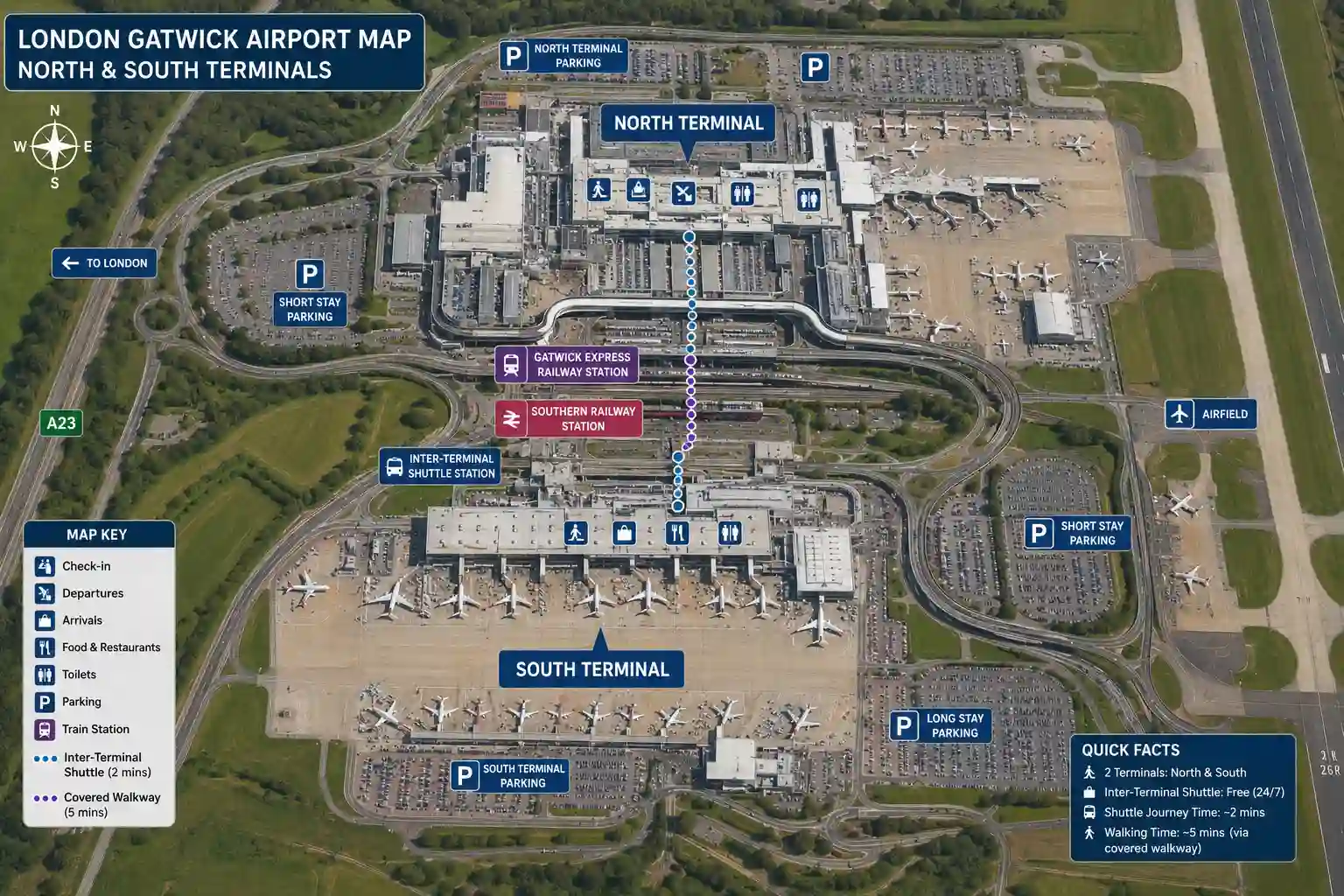
Gatwick Airport
North & South Terminal Map
North Terminal Versus South Terminal: Reading The Gatwick Terminal Map Correctly
The single biggest mistake travellers make is assuming both terminals are the same building. They are separate structures roughly ten minutes apart by shuttle, so checking your terminal on your booking confirmation before you set off is essential. A gatwick terminal map will typically colour-code North Terminal in one shade and South Terminal in another, making it easy to spot which side you need.
South Terminal is generally the busier of the two, home to more airlines, a larger retail area, and the main railway station. North Terminal tends to feel slightly quieter and handles a significant share of short-haul and charter flights. Whichever building you're using, the gatwick terminals map at the airport's official site lets you check live terminal assignments, since airlines can occasionally switch buildings.
Getting To Gatwick Airport: Road Access, Direction Signs, And Approach Routes
Road access to Gatwick Airport is mainly via the M23, which connects directly to the M25 for drivers coming from London and the wider motorway network. Clear direction signage on approach splits traffic early towards either North Terminal or South Terminal, so it helps to know your terminal before you reach the roundabout system near the airport boundary.
The airport london gatwick map shows separate access roads feeding each forecourt, which prevents unnecessary congestion at busy times. If you're being dropped off or collected, following the correct direction from the motorway avoids doubling back through the terminal loop roads, which can add fifteen minutes or more during peak periods.
Airport Transfer Options Shown On The Gatwick Airport Terminal Map
Pre-booking an airport transfer is one of the most reliable ways to avoid the stress of navigating an unfamiliar terminal layout on arrival day. A private transfer driver will already know exactly where the correct forecourt sits on the gatwick airport terminal map, meaning you're guided straight to the right pick up area without circling the one-way system.
This matters more than it might sound, particularly for early morning departures or late-night arrivals when signage can be harder to read and traffic marshals aren't always on duty. A confirmed transfer also removes the guesswork of matching your terminal to the correct drop off area shown on the london gatwick terminal map.
Choosing Your Ride: Standard Taxi Pick-Up Points Across Both Terminals
A standard taxi remains the most straightforward option for solo travellers or couples heading to or from Gatwick. Standard taxi ranks are clearly marked on the forecourt at both North and South Terminal, positioned close to the arrivals exit so you're not dragging luggage across the whole building.
Pricing for standard taxis is typically metered or fixed depending on the operator, and pre-booking is worth doing during peak travel weeks when demand at the rank can mean a longer wait. Checking the gatwick terminal map for your specific arrival gate helps you judge how far you'll need to walk to reach the taxi pick up area.
Travelling In Comfort: Executive Taxi Pick-Up Locations For Business Trips
For business travel or airport runs where comfort matters, booking an executive taxi gives you a higher standard of vehicle along with a driver who typically monitors your flight and adjusts pick-up timing automatically. Executive pick-up points are usually located within the same forecourt area as standard taxis but with dedicated meet-and-greet service.
This is particularly useful at Gatwick's South Terminal, where the arrivals hall can get crowded during peak season. Having a named driver waiting with a board means you skip the queue entirely and head straight to your vehicle, saving valuable time between flights or meetings.
Group Travel Made Simple: MPV Cars On The Gatwick Terminals Map
Families or small groups travelling with extra luggage often find MPV cars the most practical choice, since standard taxis can struggle to fit more than three passengers plus suitcases. MPV pick-up bays are marked on the gatwick terminals map alongside standard taxi zones, usually within the same forecourt but occasionally in a slightly separated bay for larger vehicles.
Booking an MPV ahead of time is strongly recommended for family holidays, since availability at the rank can be limited compared with standard cars. It also means the driver can confirm your specific terminal and forecourt zone in advance, removing any confusion on the day.
Larger Groups And Families: Minibus Pick-Up Zones At Gatwick Airport
For larger parties, sports teams, or extended families, a minibus is often the most cost-effective and practical solution. Minibus collection points are generally located in a designated coach and minibus bay rather than the standard taxi rank, so it's worth confirming the exact location when booking.
Because minibuses take longer to load and unload, drivers usually avoid the busiest section of the forecourt and use a slightly quieter bay further along. This detail rarely appears on a basic Gatwick London airport map, which is why booking directly with an operator who knows the layout well makes a genuine difference.
Comparing Gatwick Taxi Services Across North And South Terminal
Not all taxi services operate identically at both terminals, and understanding the differences helps you plan realistically. The table below summarises the key practical differences travellers should know before booking.
| Feature | North Terminal | South Terminal |
|---|---|---|
| Typical passenger volume | Lower to moderate | Higher, especially peak season |
| Rail station access | Via inter-terminal transit | Direct, on-site station |
| Taxi rank distance from arrivals | Short walk | Short to moderate walk |
| Forecourt congestion at peak times | Moderate | Higher |
| Recommended booking lead time | Same day usually fine | Advance booking recommended in peak season |
Whichever terminal you're using, pre-booking still gives the most predictable experience, since it locks in your pick up area and avoids relying on rank availability during busy periods.
Moving Between Terminals: Understanding The Gatwick Inter-Terminal Shuttle
Because North and South Terminal are separate buildings, connecting flights or mistaken terminal arrivals require the free inter-terminal shuttle, which runs continuously and takes roughly four minutes. Our inter-terminal shuttle guide covers exact timings, accessibility provisions, and what to do if you've arrived at the wrong terminal by mistake.
It's worth building in at least twenty minutes buffer if you're transferring between terminals for a connecting flight, since this accounts for walking time to the shuttle platform on both ends plus any queuing during busy periods.
North Terminal Pick-Up Points Explained Using The Gatwick Terminal Map
If you're being collected from North Terminal, the pick up area sits directly outside the arrivals hall on the forecourt's designated collection zone. Our detailed North Terminal pick-up guide walks through the exact route from baggage reclaim to the correct bay, along with where to wait if your driver is running slightly early.
Waiting times in the pick-up bay are limited, so most drivers will circle rather than park until you've cleared the doors, which is another reason a pre-arranged transfer with live flight tracking works more smoothly than asking a friend to guess your arrival time.
South Terminal Pick-Up Points Explained Using The Gatwick Terminal Map
South Terminal's pick up area follows a similar principle but covers a larger forecourt due to higher passenger numbers. Our South Terminal pick-up guide explains exactly where to stand, how the one-way system works, and how to avoid the busiest exit doors during peak arrival banks.
Because South Terminal handles more long-haul arrivals, baggage reclaim can take longer, so drivers collecting from here often benefit from flight tracking to time their arrival at the forecourt rather than waiting from the moment the flight lands.
North Terminal Drop-Off Areas: Forecourt Access And Check-In Zones
Dropping someone off at North Terminal means using the short-stay forecourt directly outside departures, which connects straight into the check-in zones once inside. Our North Terminal drop-off guide covers the free drop-off allowance, where the barriers are positioned, and what happens if you overstay the limit.
Most drop-off zones allow a short free window before charges apply, so a quick goodbye at the kerb rather than parking up is the most cost-effective approach if you're not travelling yourself.
South Terminal Drop-Off Areas: Forecourt Access And Check-In Zones
South Terminal's drop-off forecourt operates on the same short-stay principle but tends to be busier given the terminal's higher overall traffic. Our South Terminal drop-off guide details the exact lane layout, where to find the check-in zones once inside, and alternative options if the forecourt is at capacity during peak travel periods.
During school holidays and bank holiday weekends, South Terminal's drop-off area can back up quickly, so allowing extra time or considering a short-stay car park instead is often the more relaxed option.
Car Parks, Toilets, Lifts, And Restaurants: Key Facilities On Every Terminal Diagram
Beyond road access, a genuinely useful gatwick terminal map should also show internal facilities, and these are consistent across both buildings. Each terminal has multiple car parks ranging from short-stay options directly outside the building to long-stay car parks a short bus ride away, all clearly numbered on the official terminal diagram.
Inside, toilets and lifts are positioned at regular intervals throughout both the landside and airside sections, generally signposted from the main concourse. Restaurants and cafés cluster mainly in two areas: a landside selection before security and a larger airside selection once you've cleared the check-in zones and screening.
- Car parks: Short-stay for quick drop-offs, long-stay for holiday parking, with a connecting bus service.
- Toilets and lifts: Located on every level, clearly signposted from the main walkways.
- Restaurants: A mix of landside and airside dining, with airside offering the widest choice.
- Check-in zones: Organised by airline group, displayed on screens above each desk row.
Common Mistakes Travellers Make When Reading The Gatwick Airport Map
The most frequent error is confirming the wrong terminal, which can mean a stressful last-minute dash between North and South Terminal via the shuttle. Always cross-check your booking confirmation against the current gatwick airport map rather than relying on memory from a previous trip, since airlines occasionally move terminals.
Another common mistake is underestimating forecourt congestion during peak season, leading to missed pick-up windows or drop-off charges. Arriving without checking which car park or forecourt zone applies to your airline also causes unnecessary walking with heavy luggage.
Expert Tips For Using The Gatwick Airport Terminal Map More Effectively
Save a screenshot of your terminal's forecourt map before you travel, since mobile signal near the airport can occasionally be patchy in the multi-storey car parks. Cross-reference your terminal against your booking confirmation at least once more on the morning of travel, as this catches the rare cases where an airline has switched buildings.
If you're unfamiliar with Gatwick, booking a pre-arranged transfer removes almost all of the guesswork, since a driver already knows the layout, current road access conditions, and the fastest route to your specific pick up area.
Frequently Asked Questions About The Gatwick Airport Map
What is the easiest way to check which terminal I need at Gatwick?
Check your airline booking confirmation or boarding pass, which will state either North Terminal or South Terminal clearly. This is the most reliable source, more accurate than relying on a previous trip's memory.
How long does it take to walk between North and South Terminal?
You cannot walk between the terminals directly. The free inter-terminal shuttle takes around four minutes, plus a short walk to and from each platform, so allow fifteen to twenty minutes in total.
Where can I find an official Gatwick terminal map?
Gatwick Airport's official website publishes a downloadable and interactive terminal map covering both buildings, including car parks, forecourts, and internal facilities.
Is South Terminal or North Terminal closer to the train station?
South Terminal has the main railway station directly attached. Passengers arriving at North Terminal need to take the shuttle to South Terminal first to reach the trains.
What's the best drop off area if I'm running late?
Use the short-stay forecourt directly outside your terminal's departures entrance, which is the fastest route into the check-in zones. Avoid the long-stay car parks if time is tight.
Do North and South Terminal have separate car parks?
Yes, each terminal has its own dedicated car parks, though some long-stay options serve both buildings via a shuttle bus connection.
How much free time do I get in the drop off area before charges apply?
Most forecourts allow a short free window, typically around ten minutes, before charges begin. Check current signage on arrival, as allowances can change.
Can I get a taxi directly from the arrivals area?
Yes, both terminals have taxi ranks positioned close to the arrivals exit on the forecourt, though pre-booking is recommended during busy periods to avoid queuing.
What should I do if my flight arrives at a different terminal than expected?
Follow signage for the inter-terminal shuttle from arrivals, which will take you to the correct building in a few minutes without needing to leave the airport.
Are toilets and lifts available before security in both terminals?
Yes, both North and South Terminal have toilets and lifts on the landside concourse before security, as well as further facilities once airside.
Which terminal has more restaurants and shops?
South Terminal generally has a larger retail and dining selection due to higher passenger numbers, though North Terminal still offers a good range airside.
Is it possible to pre-book a specific pick up bay?
Most transfer and taxi operators assign the nearest available bay to arrivals rather than a specific numbered space, but pre-booking still guarantees a driver is waiting at the correct terminal.
What happens if I can't find my driver at the pick up area?
Contact your operator directly using the number provided at booking. Reputable transfer companies track your flight and adjust their position at the pick up area accordingly.
How do I get from long-stay parking to the terminal?
Long-stay car parks are connected by a regular shuttle bus service running to both North and South Terminal, typically every ten to fifteen minutes.
Do elderly or less mobile passengers need extra time to navigate the terminal layout?
Yes, allowing extra time is sensible, though both terminals offer accessible routes, lifts at every level, and assistance services that can be pre-booked with your airline.
Why do some flights change terminal at short notice?
Airlines occasionally reassign flights between North and South Terminal due to operational scheduling, which is why checking your confirmation on the day of travel is worthwhile.