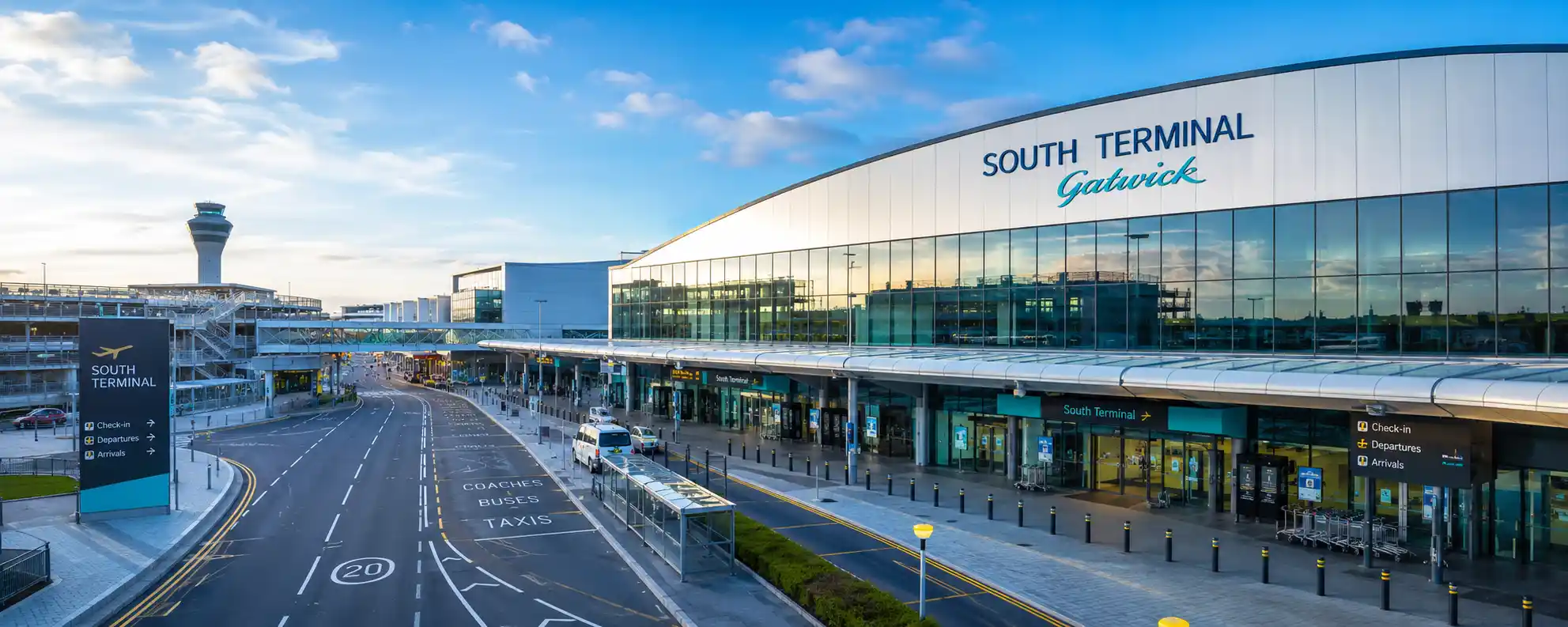
Gatwick South Terminal Map: Your Complete Guide to Every Area
Understanding the Gatwick South Terminal map makes your journey through the airport far less stressful. This London Gatwick South Terminal map guide walks you through check-in, security, the departure lounge, boarding gates, arrivals, and every passenger facility in between, so you always know exactly where you're heading. Whether you're flying with easyJet, British Airways, Virgin Atlantic, or another South Terminal airline, knowing the layout in advance saves time, reduces stress, and helps you plan connections, meet-ups, and transport with confidence.
South Terminal is Gatwick's original terminal and remains one of the busiest single-terminal buildings in Europe. Its layout is logical once you know the flow: departures sit on the upper level, arrivals on the lower level, and everything in between is arranged around a central departure lounge with two main gate piers. This guide breaks that structure down step by step.
.png) 2 Levels
2 Levels
.png) 2 Gate Piers
2 Gate Piers
.png) 24/7 Operation
24/7 Operation
.png) Rail Station
Rail Station
Understanding the Layout of the South Terminal at Gatwick
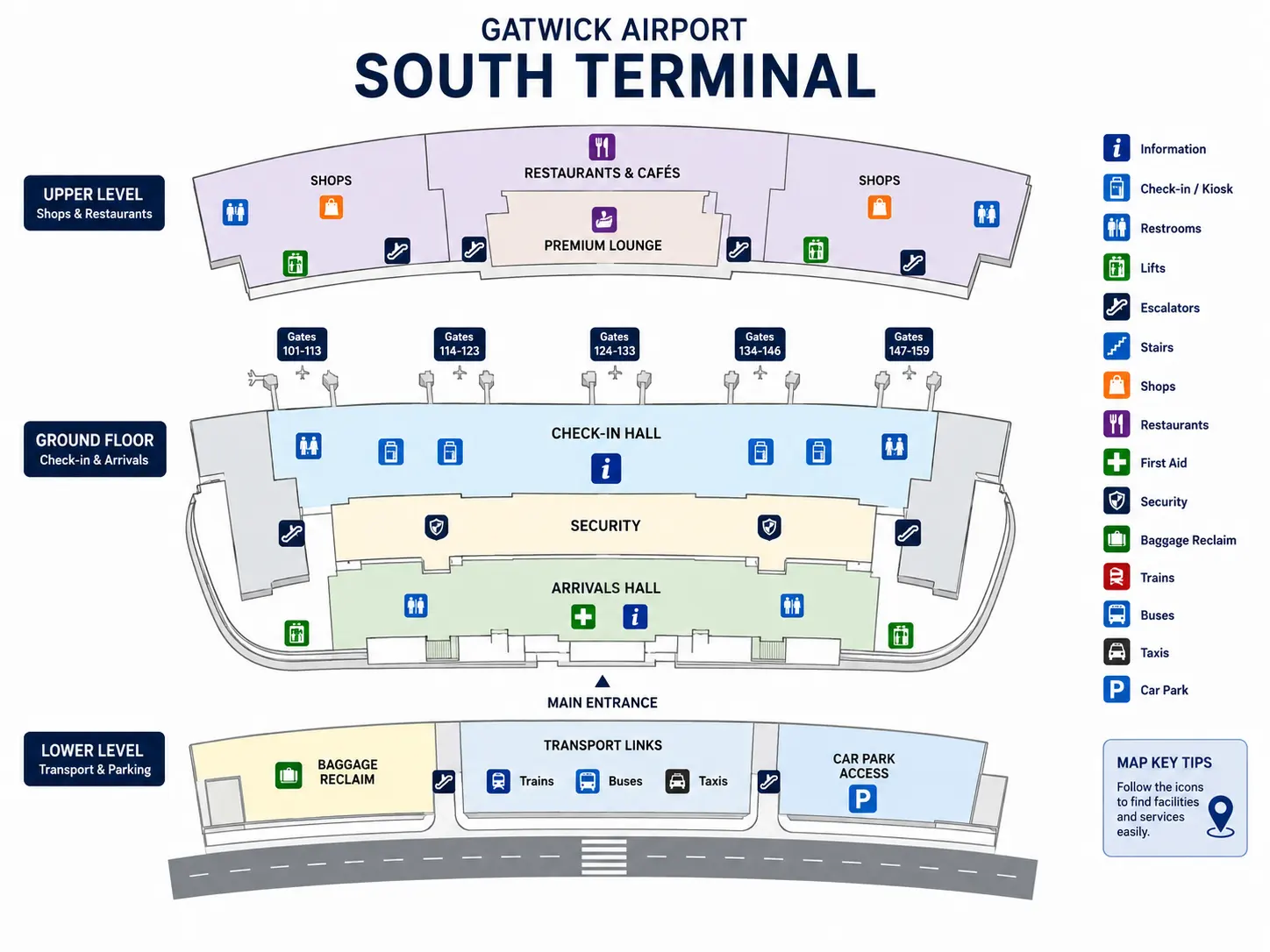
The gatwick south terminal map is essentially split across two main levels. The departures level, on the upper floor, houses check-in desks, security control, and the main departure lounge. The arrivals level, below it, handles baggage reclaim, customs, and the arrivals hall where passengers reunite with friends and family. A south terminal gatwick map also shows two gate piers, known as the North Pier and the Pier 1 extension, which lead to boarding gates for both short-haul and long-haul flights.
-
Two main levels: departures (upper) and arrivals (lower) handle all passenger flow.
-
Two gate piers: North Pier and Pier 1 extension serve both short-haul and long-haul flights.
-
Single horseshoe layout: enter at departures, move through security into the central lounge, then branch left or right towards your gate.
Quick fact
"If you're travelling to Gatwick for the first time, picture the terminal as a single large horseshoe. You enter at departures, move through security into the central lounge, then branch left or right towards your boarding gate depending on your flight number."
Gatwick Airport
South Terminal Map Guide
Departures Level: Check-In Desks, Bag Drop, and Departure Hall
The departure hall is the first space you enter when you arrive at South Terminal. Any gatwick airport south terminal map will show rows of check-in desks arranged by airline, with clear overhead signage indicating which zone handles your flight. Most airlines open check-in desks around three hours before departure and close bag drop around 40 minutes before boarding, though this varies by carrier.
Self-service check-in kiosks are available for many airlines, letting you print boarding passes and bag tags without queuing at a staffed desk. Once you've checked in, the bag drop area is typically positioned just beyond the kiosks. If you're being driven to the terminal, booking a reliable airport transfer in advance means you arrive at the correct departures entrance without last-minute stress, especially during peak summer travel periods.
Airline Check-In Zones You Should Know
Check-in desks are grouped into zones (typically labelled with letters) rather than scattered randomly. Airline check-in for easyJet, for example, often occupies a different zone to British Airways or Norwegian. Screens above the desks display live flight information, so always check these on arrival rather than relying on memory from a previous trip, as airlines occasionally move zones.
Security Control and the Departure Lounge Explained
After check-in, passengers pass through security control, which is centrally located and feeds directly into the main departure lounge. Security queues fluctuate throughout the day, with early mornings and school holiday periods typically busiest. Arriving with hand luggage packed to current restrictions speeds up this stage considerably.
The departure lounge itself is the heart of any south terminal map gatwick travellers rely on. It's a large, open retail and dining space with duty-free shopping, high-street brands, cafés, and seating areas. From here, passengers can see flight information screens showing gate numbers, which typically appear around 30 to 45 minutes before boarding. For passengers being collected or dropped off nearby, a comfortable standard taxi is often the simplest way to reach the terminal without worrying about parking.
Boarding Gates and Gate Numbers Across the Terminal
Boarding gates at South Terminal are split between two piers. Gates 1 to 7 are located within the main terminal building, while gates 101 to 117 sit within the North Pier extension, reachable via a short walk or, for some gates, an internal transit system called the shuttle transit. A gatwick south terminal gate map typically colour-codes these piers to help passengers judge walking time before boarding closes.
It's worth noting that gate numbers aren't allocated until your flight information screen confirms them, so it's not possible to know your exact gate before arriving. Once confirmed, allow extra walking time if you're assigned a gate in the North Pier, particularly if travelling with young children or reduced mobility. Business travellers heading to meetings straight after landing often prefer booking an executive taxi in advance, ensuring a smooth, professional transfer the moment they clear arrivals.
Arrivals Level and the Arrivals Hall Passenger Flow
The arrivals level sits directly below departures and is where all inbound South Terminal flights bring passengers after landing. Passengers pass through border control, collect baggage from the reclaim belts, and exit through customs into the main arrivals hall. This is the public meeting point area, complete with a café, seating, and a clearly marked pick-up zone.
Families or groups travelling together often find the arrivals hall busy, particularly around midday and early evening when several long-haul flights land in quick succession. If you're meeting a larger group or travelling with substantial luggage, an MPV car offers more space and comfort than a standard vehicle, making the journey from arrivals noticeably easier.
Food Court, Shops, and Passenger Services in South Terminal
Beyond navigation, most passengers want to know what facilities are available once they're through security. The South Terminal food court offers a broad mix of cafés, restaurants, and grab-and-go outlets, catering to early departures and delayed flights alike. Duty-free shopping, high-street fashion outlets, and gift shops line the departure lounge.
Practical passenger services are well distributed throughout the terminal. There's an airport pharmacy for last-minute medication or travel essentials, currency exchange desks for last-minute foreign currency, and several ATMs positioned near the departure lounge and arrivals hall. Charging points are dotted around seating areas, and free Wi-Fi covers the entire terminal, useful for checking boarding passes or contacting your driver. Groups travelling together for weddings, corporate trips, or family holidays often arrange a minibus in advance to keep everyone moving as one unit rather than splitting into multiple vehicles.
Getting to South Terminal by Road, Rail, and Airport Transfer
South Terminal has its own dedicated station, South Terminal railway station, connected to London Victoria, London Bridge, and the wider Southern and Gatwick Express network. It's also directly accessible by road, with a dedicated set-down area right outside the terminal entrance.
For door-to-door convenience, many passengers prefer booking dependable taxi services rather than juggling train timetables and platform changes, particularly with early flights or heavy luggage. A pre-booked transfer also removes the uncertainty of taxi rank queues during busy periods, which can build quickly around peak departure times.
Parking, Drop-Off Points, and Terminal Access Considerations
Short-stay and long-stay car parks serve South Terminal directly, with drop-off zones positioned close to the departures entrance for a quick, efficient exit. If you're being dropped off, allow a few extra minutes during school holidays and bank holiday weekends, as the set-down area gets noticeably busier.
Passengers who'd rather avoid parking charges altogether often choose a pre-arranged transfer instead. Reviewing Gatwick's official Inter-Terminal Shuttle Guide is a smart move if your journey involves connecting between terminals, since South Terminal and North Terminal are not within walking distance of one another.
Moving Between North and South Terminal via the Shuttle
Gatwick's two terminals are connected by an automated shuttle transit system rather than a walkway, and the journey typically takes around two to three minutes. This matters if your flight has changed terminal, or if you're connecting between airlines that operate from different buildings. Our detailed inter-terminal shuttle guide covers timings, accessibility, and what to expect step by step.
It's a common mistake to assume both terminals share the same check-in and security areas. They don't. Always confirm your terminal on your boarding pass or airline confirmation email before travelling, since arriving at the wrong terminal can mean a rushed shuttle transfer under time pressure.
How South Terminal Compares With Gatwick's North Terminal
South Terminal is generally considered Gatwick's busier and more established terminal, historically hosting a wider mix of short-haul and long-haul carriers, though airline allocations do shift over time. North Terminal has its own distinct layout, security area, and gate system entirely separate from South Terminal.
If you're unsure which terminal you're flying from, our North Terminal Pick-Up Guide explains that terminal's layout in the same depth as this article covers South Terminal, helping you compare both before you travel.
| Feature | South Terminal | North Terminal |
|---|---|---|
| Gate piers | Two (main building + North Pier) | One main pier |
| Rail station | South Terminal station | Reached via shuttle |
| Typical use | Wide mix of short and long-haul | Mostly short-haul and charter |
Being Picked Up From South Terminal: What to Know Before You Land
Meeting a passenger at South Terminal arrivals is straightforward once you know where the pick-up zone sits relative to the terminal exit. Drivers typically wait in a designated area a short walk from the arrivals hall doors, with clear signage guiding passengers there. Our full South Terminal Pick-Up Guide details exact waiting areas, timing advice, and how to coordinate with your driver if a flight lands early or late.
Booking ahead rather than relying on the taxi rank is particularly useful for late-night arrivals or long-haul flights where queues can build unpredictably after several aircraft land close together.
Understanding South Terminal Drop-Off Compared to North Terminal
Drop-off procedures differ slightly between Gatwick's two terminals, largely due to layout rather than rules. At North Terminal, our North Terminal Drop-Off Guide explains how the set-down area connects to check-in, which is worth comparing if your itinerary involves both terminals across a single trip, such as an outbound flight from one and a return into the other.
Knowing these differences in advance prevents drivers from circling the wrong terminal on a tight schedule, which is a surprisingly common and entirely avoidable mistake among passengers unfamiliar with Gatwick's two-terminal layout.
Step-By-Step Drop-Off Guidance for South Terminal Departures
For a smooth departure, our South Terminal Drop-Off Guide sets out the full process from arrival at the set-down zone through to the departures hall entrance, including where to go if you need to return a hire car or handle oversized luggage before check-in.
Following a clear step-by-step approach removes the guesswork, particularly for passengers unfamiliar with Gatwick, and pairs well with the check-in and security information covered earlier in this guide.
Common Mistakes Passengers Make When Reading a South Terminal Map
The most frequent mistake is confusing gate numbers with pier locations, leading to a rushed walk in the wrong direction. Another common error is assuming both Gatwick terminals share facilities, when in fact each has entirely separate check-in, security, and departure lounge areas.
Passengers also sometimes underestimate walking time to North Pier gates, particularly during their first visit. Checking the flight information screens as soon as you enter the departure lounge, rather than waiting until close to boarding, avoids this issue entirely.
Best Practices for Navigating South Terminal Efficiently
Arrive with your terminal confirmed in advance, check flight information screens regularly once inside, and allow extra time if your gate is in the North Pier. Keep essential items accessible for security control, and use the free Wi-Fi to track any last-minute gate changes.
For families, arriving slightly earlier than the standard recommended time reduces pressure at check-in and security, particularly with pushchairs or additional baggage. These small habits, built from years of regular airport travel, make the difference between a relaxed departure and a rushed one.
Final Thoughts on Using the Gatwick South Terminal Map With Confidence
Once you understand how the gatwick south terminal map is structured, the whole terminal becomes far easier to navigate, from check-in through security to your boarding gate, and back through arrivals on your return. Whether you're planning your first trip through South Terminal or simply refreshing your memory before a return visit, knowing the layout in advance turns a potentially stressful airport experience into a smooth, predictable one.
Frequently Asked Questions About the Gatwick South Terminal Map
Where can I find an official London Gatwick South Terminal map?
Gatwick Airport publishes an official terminal map on its website and via terminal information screens, showing check-in zones, security, the departure lounge, and gate piers.
Is the gatwick south terminal map the same for departures and arrivals?
No. Departures and arrivals sit on different levels, so a single gatwick airport map south terminal view usually shows both levels separately for clarity.
How do I get from South Terminal to North Terminal?
Via the automated inter-terminal shuttle, which takes roughly two to three minutes and runs continuously throughout the day.
Do gate numbers appear on the south terminal gatwick map in advance?
No. Gates are only confirmed on flight information screens around 30 to 45 minutes before boarding, so they're never fixed on a printed map.
How early should I check the map of gatwick south terminal before travelling?
Reviewing it the night before or on the morning of travel is usually enough, since the core layout rarely changes, though airline zones can shift occasionally.
Are check-in desks grouped by airline on the south terminal map gatwick shows?
Yes, check-in desks are organised into lettered zones by airline, with overhead signage confirming the correct zone for your flight.
What facilities are near the departure lounge?
Duty-free shopping, cafés, restaurants, an airport pharmacy, currency exchange, ATMs, and charging points are all within or near the main departure lounge.
Can I walk between all gates shown on the gatwick south terminal gate map?
Most gates are reachable on foot, though gates in the North Pier require a longer walk, and some connect via an internal shuttle for speed.
Is there Wi-Fi throughout South Terminal?
Yes, free Wi-Fi covers the entire terminal, including the departure lounge, gate areas, and arrivals hall.
What happens if my flight changes gate at the last minute?
Gate changes are announced on flight information screens and via airport tannoy; always check screens near your gate rather than relying on an earlier announcement.
Where do I meet someone arriving at South Terminal?
The main meeting point is in the arrivals hall, just beyond customs, where there's seating and a café for waiting.
Do elderly or less mobile passengers need extra time using the south terminal map gatwick provides?
Yes, allowing extra time for North Pier gates and requesting airport assistance in advance is recommended for passengers with reduced mobility.
Is parking available close to South Terminal?
Yes, short-stay parking sits close to the terminal entrance, with long-stay options a short transfer away.
Why do some gatwick airport south terminal map versions look different online?
Layouts are occasionally updated as retail units or check-in zones change, so it's worth checking the current official map close to your travel date.
Can I use a london gatwick airport south terminal map on my phone at the airport?
Yes, most travellers view the map digitally via the Gatwick website or app, alongside physical signage throughout the terminal.
What's the fastest way through South Terminal with hand luggage only?
Self-service check-in kiosks and priority security lanes (where available) significantly reduce time from arrival to departure lounge.
Do all South Terminal flights use the North Pier gates?
No, gates 1 to 7 are within the main terminal, while gates 101 to 117 are in the North Pier, so allocation depends on your specific flight.
Is currency exchange available on both departures and arrivals levels?
Yes, currency exchange desks are typically located on both levels, though opening hours can vary by outlet.