
Gatwick Airport Drop Off Charges 2026: Fees, Payment, Free Tips
Quick answer: Gatwick airport drop off charges are £10 for up to 10 minutes on the terminal forecourts, then £1 for every extra minute, capped at £30 for a maximum stay of 30 minutes. There are no barriers and no ticket machines. ANPR cameras record your vehicle entry, and you must pay online by 23:59 the day after your visit. Miss that payment deadline and Gatwick issues a £100 Parking Charge Notice.
That is the short answer. The longer answer matters just as much, because most drivers who get caught out at Gatwick do not object to the fee itself. They get stung because they did not realise a charge applied, did not know how to pay, or assumed a payment machine would be waiting for them somewhere. This guide explains exactly how the drop off charges at Gatwick Airport work, how the payment system operates, what the penalties are, who is exempt, and how to drop someone off without paying a penny if you plan ahead.
.png) From £10
From £10
.png) 30-Minute Maximum
30-Minute Maximum
.png) Pay Online
Pay Online
.png) Free Options
Free Options
How Much Is the Drop Off Charge at Gatwick Airport Right Now?
The current charge is £10 for a stop of up to 10 minutes. From minute 11 onwards, Gatwick adds £1 per minute, so a 15-minute stop costs £15 and a 20-minute stop costs £20. The maximum charge is £30, which also marks the maximum permitted stay of 30 minutes. Stay longer than half an hour and you risk enforcement action on top of the capped fee.
-
Charge: £10 for up to 10 minutes
-
Extra time: £1 per additional minute
-
Maximum stay: 30 minutes (capped at £30)
-
System: barrierless, with automatic number plate recognition (ANPR)
-
Payment deadline: 23:59 the day after your visit
-
Exemption: Blue Badge holders, once their vehicle is registered in advance
Key takeaway
The £10 rate took effect on 6 January 2026, when Gatwick raised the fee from £7. That was a 43% increase in a single step, and it makes the London Gatwick airport drop off charge one of the highest kerbside fees at any UK airport. When forecourt charging first began in March 2021, the fee was £5 for 10 minutes, so the cost of a quick passenger drop off has doubled in five years.
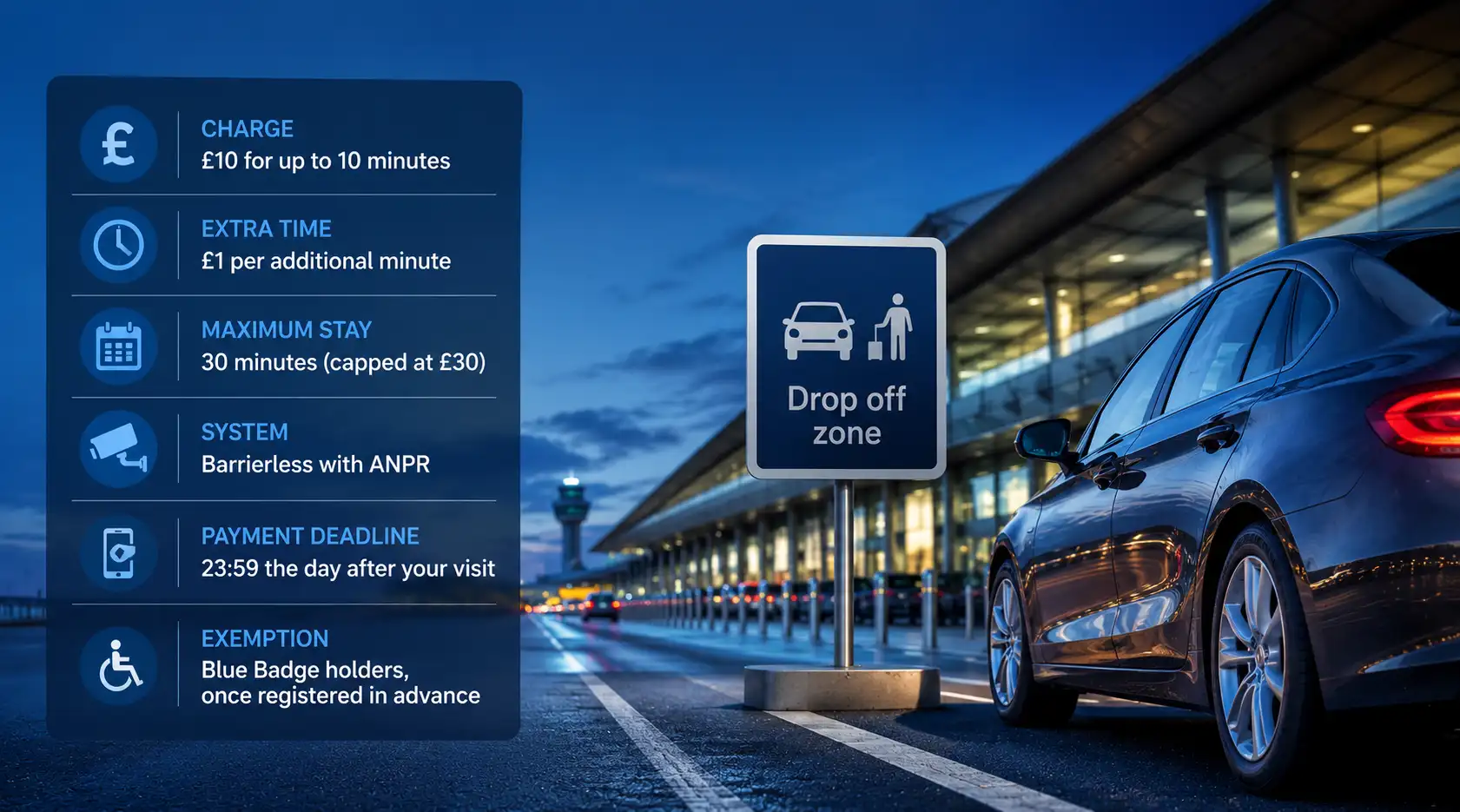
Drop off zone
£10 for 10 minutes · ANPR
Breaking Down the Gatwick Drop Off Fee Structure: What Your Money Actually Covers
Beyond the headline £10 for 10 minutes, understanding how Gatwick's tiered pricing works can save you from unexpected costs. The airport operates a sliding scale that rewards quick stops and penalises lingering, with the meter starting to run from the moment your vehicle crosses the ANPR entry point.
What many drivers don't realise is that the clock doesn't reset if you move within the forecourt. You're charged for the total elapsed time between entry and exit, regardless of whether you circled the terminal or parked in different spots. This means every minute counts, and the difference between a 9-minute and 11-minute stop is £11, not just £1.
| Stop Duration | Total Cost | Effective Per-Minute Rate |
|---|---|---|
| Under 5 minutes | £10 | £2.00+ per minute |
| Exactly 10 minutes | £10 | £1.00 per minute |
| 15 minutes | £15 | £1.00 per minute |
| 20 minutes | £20 | £1.00 per minute |
| 25 minutes | £25 | £1.00 per minute |
| 30 minutes (max) | £30 | £1.00 per minute |
Cost comparison insight
The economics are stark: a 10-minute stop costs £10 (£1/min), while a 5-minute dash costs the same £10 (£2/min). This means you're effectively paying a "landing fee" of £10 just to access the kerb, with additional minutes priced at a more reasonable £1 each. The financial incentive is clear - if you're going to pay the charge anyway, take the full 10 minutes to unload properly rather than rushing.
The cap at £30 for 30 minutes is worth examining. While it limits your exposure, it also represents the maximum time Gatwick permits on the forecourt. Drivers who exceed 30 minutes not only pay the £30 but also risk additional enforcement action, which can include fines beyond the capped fee. The message is unambiguous: the forecourt is for dropping off, not for waiting, socialising, or reorganising luggage at leisure.
For context, compare this to other paid drop-off scenarios. A 10-minute stay at Gatwick costs the same as some airport meals or a day's parking in many town centres. The difference is that the forecourt fee is designed specifically to discourage private vehicles from lingering, keeping the kerbside clear for the high volume of passengers passing through daily. Whether you consider it reasonable or not, understanding the pricing psychology helps explain why the airport has stuck with this model since its introduction in 2021.
How ANPR Cameras Track Vehicle Entry on the Gatwick Forecourt
Gatwick uses automatic number plate recognition rather than barriers. ANPR cameras positioned at the entry and exit of each forecourt photograph every plate, timestamp the visit, and calculate how long the vehicle stayed. The system is entirely barrier-free, which keeps traffic moving but also removes the physical prompt that reminds drivers a fee exists.
This is worth understanding, because the number plate recognition system explains almost every complaint drivers raise about the drop off charge at Gatwick Airport:
- You will not receive a ticket. Nothing is handed to you and nothing appears on your windscreen. The record sits in the system against your registration.
- You will not necessarily receive a reminder. Unless you have registered for an account, the first correspondence you receive may be the penalty notice itself, sent to the registered keeper's address.
- Cloned or misread plates can be challenged. If you genuinely never entered the forecourt, the appeals process allows you to dispute the charge with evidence.
- Multiple entries mean multiple charges. If you loop out of the zone and come back in, the ANPR cameras log a second visit, and a second fee applies.
The forecourt zones are clearly signed on the approach roads, with the charge displayed before the point of no return. Even so, in the stress of airport traffic, plenty of drivers sail past the signs. Treat any road that leads directly to the terminal doors as a charged zone unless signage tells you otherwise.
Where the Drop Off Charges at Gatwick Airport Actually Apply
The charges apply only to the designated forecourt zones directly outside the North Terminal and South Terminal. These are the lanes closest to the terminal entrances, where you can stop, unload luggage, and let passengers walk straight into departures. The airport forecourt is the most convenient place to stop, which is precisely why it carries a premium.
The charge does not apply to the wider airport road network. Driving past Gatwick on the M23 or A23, using the fuel station, or heading straight into a car park does not trigger the forecourt fee, although car parks have their own tariffs. The Long Stay car parks, covered later in this guide, offer a free window specifically so drivers have a genuine parking alternative.
One quirk regular drivers learn quickly: Gatwick's two terminals sit about a mile apart, connected by an inter-terminal shuttle. If you drop someone at the wrong terminal and then drive round to the correct one, you enter two separate charging zones and pay twice. Checking which terminal your passenger's airline uses before setting off is one of the simplest ways to protect yourself, and it is the kind of detail an experienced Gatwick Airport taxi specialist confirms as standard before every journey. Airlines do occasionally move between terminals, so check close to your travel date rather than relying on memory from a previous trip.
How to Pay Gatwick Airport Drop Off Charge Online Before Midnight
You pay online through Gatwick's official drop off payment portal, which is operated on the airport's behalf by NCP. There is no cash option and no payment kiosk on the forecourt itself. The steps take about two minutes:
- Go to the official portal. Search for "Gatwick drop off payment" and use the link on the official Gatwick Airport website, or follow the web address shown on the forecourt signage. Avoid third-party sites that appear in adverts, as copycat payment pages exist for many UK airports.
- Enter your vehicle registration. The system matches your plate against the ANPR record of your visit.
- Confirm the date and duration. Check the visit shown matches the day and terminal you used, especially if you drive to Gatwick often.
- Pay by card. Debit and credit cards are accepted, and the receipt is emailed to you. Keep it until you are certain no further correspondence arrives.
The payment deadline is 23:59 on the day after your visit. Drop someone off on Friday morning and you have until midnight on Saturday to pay. This is more generous than it sounds when you are relaxed at home, and far less generous when you have flown out on holiday yourself and forgotten all about it. If you are travelling too, pay before you go through security or set a phone reminder. Many people whose journey starts with a pre-booked airport transfer service avoid this problem entirely, because a licensed operator absorbs the forecourt fee into the fare and handles the payment themselves.
If you use the forecourt regularly, look at registering an account on the portal. Registered users can store their vehicle and card details so that future visits are settled through an automatic payment system rather than a manual transaction each time. For anyone doing school-run-style airport trips for family several times a year, this removes the single biggest risk, which is simply forgetting.
Gatwick Airport Drop Off Charges Payment Methods and Deadlines
| Payment method | Available? | Notes |
|---|---|---|
| Online payment by debit or credit card | Yes | The standard route via the official portal, open until 23:59 the day after your visit |
| Registered account with stored card | Yes | Automatic payment collection for each logged visit, ideal for frequent drivers |
| Telephone payment | Limited | A phone option is signposted for drivers who cannot pay online; check current signage for the number |
| Cash | No | There are no machines or kiosks on the forecourt |
| Paying on a later date | No | After the deadline, the charge converts to a Parking Charge Notice |
Two habits make the Gatwick airport drop off charges payment process painless. First, pay before you leave the airport perimeter if you can, sitting safely parked rather than trusting your memory later. Second, screenshot the confirmation. In the rare event of a system mismatch, dated proof that you attempted to pay online is the strongest evidence you can hold.
For most private drivers the fee is a minor irritation, but for anyone weighing up whether to drive at all, it is worth pricing the whole journey honestly: fuel, the forecourt fee, and the stress of airport traffic. A standard saloon taxi with a fixed fare that already includes the drop off charge often works out closer in cost than people expect, particularly for solo travellers or couples heading to Gatwick from Surrey, Sussex or South London.
What Happens If You Miss the Payment Deadline at London Gatwick
An unpaid charge becomes a Parking Charge Notice of £100, posted to the registered keeper of the vehicle. Pay the PCN within 14 days and it reduces to £60. Ignore it beyond the stated period and the operator can pursue the full amount, add debt recovery costs, and ultimately take court action. A forgotten £10 fee can therefore snowball into a three-figure bill over a stop that lasted less than the time it takes to check in a suitcase.
If a PCN lands on your doormat, act in this order:
- Check the details. Confirm the plate, date, time and location match a journey you actually made. ANPR errors are rare but not unheard of.
- Decide quickly. The discounted rate is time-limited. If the charge is legitimate, paying within the 14-day window saves £40.
- Appeal if you have grounds. Genuine grounds include a misread plate, a vehicle sold before the visit, a medical emergency, or evidence that you did pay the original fee. Follow the appeals route printed on the notice and keep copies of everything.
- Do not simply ignore it. Private parking charges at UK airports are enforceable, and ignoring correspondence removes your discount and your easiest appeal options.
The most common reason for an unpaid charge is not defiance but distraction. Drivers dropping relatives for an early flight, then driving home in the dark, simply forget. If your circumstances make forgetting likely, either use the free Long Stay option or hand the whole task to a professional. Business travellers in particular often choose an executive taxi option precisely because the driver deals with terminal access, timing and the fee, leaving nothing to remember afterwards.
Free Shuttle Bus Option: Avoid the Drop Off Charge at Gatwick
You can drop off at Gatwick completely free of charge. The airport's Long Stay car parks at both terminals allow up to two hours free, and a free shuttle bus runs between the Long Stay car park and the terminal every few minutes for most of the day. This is Gatwick's official free alternative, and for anyone with a little spare time it turns a £10 stop into a £0 one.
Here is how the free shuttle bus route works in practice:
- Follow signs for the Long Stay car park serving your passenger's terminal, not the forecourt.
- Park in a normal bay and note where you stopped.
- Walk your passenger to the shuttle stop inside the car park. Buses run frequently and the ride to the terminal takes only a few minutes.
- Wave them off, return to your car, and leave within the two-hour free window. Exit even one minute late and standard parking tariffs apply, so do not cut it fine.
The trade-offs are real, and it pays to be honest about them. The shuttle adds 15 to 30 minutes to the journey door to door. Passengers must handle their own luggage on and off the bus. On a wet January morning with two children, four suitcases and a buggy, the forecourt's £10 starts to look good value. Larger groups sometimes solve the problem differently: rather than one person driving and paying to drop off, families travelling together book spacious MPV cars so everyone rides in a single vehicle to the terminal doors, with the charge built into the fare and no one left to drive home.
South Terminal drivers occasionally use a second unofficial option: free lay-bys on the A23 near the Longbridge roundabout, roughly a 10 to 15 minute walk from the terminal. It costs nothing, but it only suits fit passengers with light luggage, and it should never be used as a waiting spot for arrivals, as local restrictions are enforced.
Blue Badge Exemptions and Discounts on Gatwick Drop Off Fees
Blue Badge holders can use the forecourt without paying, but only if the vehicle is registered for exemption with NCP, the operator that administers the drop off charges Gatwick Airport applies. This is the detail that catches people out: displaying the badge in the windscreen does nothing on its own, because the ANPR cameras read plates, not badges. Registration must be completed through the official exemption process before or shortly after travel, following the instructions on Gatwick's website.
Practical guidance for accessible drop offs:
- Register the vehicle, not just the badge holder. If a relative with a different car drives the badge holder next time, that vehicle needs registering too, or the standard fee applies.
- Keep the badge details current. Expired badges invalidate the exemption, and renewals are not transferred automatically.
- Allow extra time on the forecourt. Exempt vehicles still need to respect the maximum stay, so passengers who need longer to board should consider the airport's dedicated assistance services, arranged in advance through the airline.
- Ask about assistance from the car park. If you use the free Long Stay route instead, Gatwick's special assistance team can support passengers from designated points, which suits some travellers better than a rushed forecourt stop.
Groups travelling with a wheelchair user plus family and luggage often find neither the forecourt nor the shuttle ideal. In those cases a pre-booked vehicle with proper boot space and boarding time, such as an eight-seat minibus hire with a driver briefed on the passenger's needs, removes the time pressure entirely and delivers everyone to the terminal together.
Collecting Passengers at Gatwick Airport: Pick Up Rules Guide
Pick ups use the same forecourt zones as drop offs, so the same fee structure applies: £10 for 10 minutes, £1 per additional minute, £30 and 30 minutes maximum. The difference is that collecting passengers is far harder to time. Flights land early or late, baggage reclaim can take anywhere from 10 minutes to over an hour, and every minute you sit waiting on the forecourt is metered.
The smart approach to collecting passengers works like this:
- Track the flight, not the schedule. Use a live flight tracker or Gatwick's arrivals page rather than the ticketed landing time.
- Wait off-airport or in the Long Stay. Park free in the Long Stay car park for up to two hours while your passenger lands, clears passport control and collects bags.
- Move only on the "bags collected" message. Ask your passenger to text once they have their luggage and are walking out. Only then head for the forecourt, or better, have them ride the free shuttle to the Long Stay and meet you at the car for nothing.
- Agree a precise meeting point. "Outside departures" is vague at an airport with two terminals. Name the terminal, the zone and a landmark.
The financially painful scenario is circling. Drivers who arrive too early sometimes loop in and out of the forecourt waiting for their passenger to emerge, and every re-entry is a fresh charge. Two loops plus a 12-minute final stop can cost more than £30 in total. For group arrivals, when several family members land together with holiday luggage, many people skip the juggling act and book a 6 seater taxi in London or from the home counties, so the driver monitors the flight, waits included, and nobody watches a meter tick on the forecourt.
How London Gatwick Drop Off Charges Compare with UK Airports
The London Gatwick airport drop off charge sits at the very top of the UK table. Here is how the major airports compare on their initial kerbside fee in 2026:
| Airport | Initial drop off fee | Initial time allowed | Free alternative |
|---|---|---|---|
| London Gatwick | £10 | 10 minutes | Long Stay car park, 2 hours free with shuttle |
| London Stansted | £10 | 15 minutes | Mid Stay car park with free time |
| London City | £8 | Short initial window | Limited; check current terms |
| London Heathrow | £7 | Per visit | Long Stay car parks with free period |
| London Luton | £7 | 10 minutes | Mid-term parking with free window |
| Manchester | £5–£6 | Short initial window | Free drop off zone with shuttle |
| Birmingham | Free | First 10 minutes | Forecourt itself is free initially |
Fees at other airports change frequently, so treat this table as a snapshot and verify each airport's own site before travelling. The pattern, though, is stable: Gatwick and Stansted lead on price, and Gatwick's per-minute metering after 10 minutes differs from Stansted's banded structure, which jumps to a flat £28 for stays between 15 and 30 minutes. For a stop between 15 and 27 minutes, Gatwick's meter is actually the cheaper of the two despite the identical headline fee.
What the comparison really tells you is that kerbside charging is now the norm, and budgeting for it belongs in your travel planning alongside luggage allowances and check-in times. For a full car of travellers, the calculation shifts again. Once you divide a fixed fare between five or six people, the per-head cost of a 7 seater taxi to Gatwick frequently undercuts the combined cost of fuel, forecourt fees at both ends of the trip, and the favour owed to whoever drove.
Common Mistakes Drivers Make with Drop Off Charges at Gatwick
After watching thousands of forecourt stops, professional airport drivers see the same errors on repeat. Avoid these and you will avoid almost every problem the drop off charge Gatwick Airport enforces:
- Assuming there is a barrier or machine. There is not. The system is camera-only, and payment is your responsibility to initiate.
- Missing the payment deadline. Midnight the day after your visit arrives faster than you think, especially if you also flew out. Pay immediately or set a reminder before you leave the car park.
- Paying on a copycat website. Sponsored search results sometimes surface unofficial payment pages that add fees or harvest card details. Use the address on the official signage.
- Sitting on the forecourt waiting for arrivals. At £1 per minute after the first ten, waiting is the most expensive thing you can do at Gatwick. Wait in the Long Stay instead.
- Looping in and out of the zone. Every re-entry is a new charge. One visit, timed well, is the goal.
- Going to the wrong terminal. Two forecourts a mile apart means a wrong guess doubles your cost. Check the airline's terminal the day before.
- Relying on the Blue Badge alone. Exemption requires vehicle registration with the operator, not just a badge on the dashboard.
- Overstaying the free Long Stay window. Two hours is generous, but the transition to paid parking is automatic and unforgiving.
There is one more mistake that has nothing to do with the fee: squeezing seven people and a holiday's worth of luggage into a car built for five, purely to save on a second vehicle. Beyond being uncomfortable, an overloaded car is a safety and insurance risk. Large groups travelling together are better served by an 8 seater taxi with genuine luggage capacity, which also means only one forecourt fee for the entire party rather than two or three.
Expert Tips to Make Every Gatwick Airport Drop Off Stress Free
Pulling everything together, here is the checklist experienced Gatwick drivers run through before every trip:
- Confirm the terminal against the airline and booking reference the day before travel.
- Decide your strategy in advance: forecourt for speed at £10, Long Stay and free shuttle bus for zero cost, or a pre-booked ride so someone else handles all of it.
- Load the car strategically. Bags that come out first go in last. A well-packed boot turns a 10-minute stop into a 4-minute one.
- Say goodbyes before you arrive. The forecourt is for unloading, not lingering. Emotional farewells belong at home or in the car park.
- Pay online the moment you are safely parked after leaving, or use a registered account so the pay online step happens automatically.
- Keep your receipt until well after the payment deadline has passed.
- For pick ups, wait free and move late. Long Stay first, forecourt only when your passenger is kerbside-ready.
- Budget the fee into the trip. £10 out, £10 back if you are collecting later. Knowing the number in advance removes the sting.
The final decision is simply whether driving is worth it at all. Add fuel, forecourt fees, airport traffic and the early alarm, and many travellers conclude that door-to-door professional taxi services with fixed fares, flight monitoring and the drop off charge already included deliver better value than they assumed, especially for early departures, late arrivals and group travel. Whichever route you choose, choose it before you set off. Every expensive mistake at Gatwick's kerbside comes from deciding under pressure.
Gatwick Airport Drop Off Charges: Frequently Asked Questions
How much is the drop off charge at Gatwick Airport in 2026?
£10 for up to 10 minutes on the North or South Terminal forecourt, then £1 per additional minute, capped at £30 for a maximum stay of 30 minutes. The £10 rate applies from 6 January 2026, up from the previous £7.
How do I pay Gatwick airport drop off charge after my visit?
Pay online through the official drop off payment portal linked from Gatwick's website, entering your vehicle registration and paying by card. You have until 23:59 the day after your visit. There is no cash option and no machine on the forecourt.
What happens if I forget to pay the drop off charge at Gatwick Airport?
The unpaid charge becomes a £100 Parking Charge Notice sent to the registered keeper, reduced to £60 if paid within 14 days. Continued non-payment can lead to debt recovery costs and court action, so pay or appeal promptly.
Can I drop off at Gatwick for free?
Yes. Park in the Long Stay car park at either terminal, which is free for up to two hours, and your passenger rides the free shuttle bus to the terminal. It adds roughly 15 to 30 minutes but costs nothing if you leave within the free window.
Does the drop off charge Gatwick Airport applies also cover picking people up?
Yes, pick ups use the same forecourt and the same fee structure. To collect for free, wait in the Long Stay car park and have your passenger take the free shuttle bus out to meet you at the car.
Do taxis pay the drop off charges Gatwick Airport enforces?
Vehicles entering the charging zone are logged regardless of type. Licensed operators typically build the fee into fixed fares and settle it through the drop off payment portal or an account, so passengers do not need to do anything themselves.
Is there a payment machine on the Gatwick forecourt?
No. The system is barrier-free and cashless. ANPR cameras log your vehicle entry and exit, and the Gatwick airport drop off charges payment must be completed online or by the signposted phone option before the deadline.
How long can I stay on the Gatwick forecourt?
The maximum stay is 30 minutes, at a maximum cost of £30. Exceeding 30 minutes can trigger enforcement beyond the capped fee, so anything longer than a quick unload should happen in a car park instead.
Are Blue Badge holders exempt from the London Gatwick airport drop off charge?
Yes, but only if the vehicle is registered for exemption with NCP through Gatwick's official process. Displaying the badge alone does not work, because the cameras read number plates rather than badges.
Which is cheaper for drop offs, Gatwick or Heathrow?
Heathrow, at £7 per visit against Gatwick's £10 for 10 minutes. Among London airports, Gatwick and Stansted share the highest headline fee, although Gatwick's per-minute metering can be cheaper than Stansted's £28 flat band for stays of 15 to 27 minutes.
What if my flight is delayed and someone is coming to collect me?
Ask them to track your flight live and wait in the Long Stay car park, which is free for two hours, rather than on the metered forecourt. They should only drive to the pick up point, or meet you off the free shuttle, once you have your bags and are ready to walk out.
Can I pay the Gatwick drop off fee in advance?
Payment is linked to your actual ANPR-recorded visit, so the standard route is to pay online after the visit and before the deadline. Frequent users can register an account with stored card details so each visit is charged automatically without a manual payment.
I entered the forecourt by mistake and drove straight through. Do I still pay?
If your plate was recorded entering the zone, a charge is generated even for a brief pass-through. Pay the standard fee to avoid a penalty, and use the appeals process only if you believe the record itself is wrong, for example a misread plate.
What is the best option for a family with young children and lots of luggage?
If budget matters more than time, one adult can escort the family via the Long Stay and free shuttle. If simplicity matters more, the £10 forecourt stop or a pre-booked MPV with the fee included in the fare are the least stressful choices, since both deliver children, buggies and cases directly to the terminal doors.
Do the drop off charges at Gatwick Airport apply at night?
Yes. The ANPR system operates around the clock, so a 4 a.m. drop for an early departure is charged exactly like a midday one. The free Long Stay alternative also remains available, though shuttle frequency can be lower in the small hours, so allow extra time.
How do I prove I paid if I receive a penalty notice anyway?
Respond through the appeals route on the notice, attaching your payment confirmation email or a screenshot showing the date, registration and amount. This is why saving the receipt from the portal until well after your travel date is worth the ten seconds it takes.
Charges, deadlines and exemption rules are set by Gatwick Airport and its operator and can change at any time. The figures in this guide reflect the published 2026 tariff; always confirm against the official Gatwick Airport website and on-site signage before you travel.
Table of contents
Related Gatwick Airport Guides
Get to know Gatwick Airport better before your journey. From drop-off charges to parking options and taxi services, these related reads help you plan your airport visit with confidence and avoid unexpected fees.
Hotels Close to Gatwick South Terminal
Find hotels close to Gatwick South Terminal for convenient stays, easy access, parking, and early flights.
Read More arrow_forwardHotels Close to Gatwick North Terminal
Explore hotels close to Gatwick North Terminal for convenient stays, easy access, parking, and early flights.
Read More arrow_forwardGatwick Airport Hotels With Free Parking
Find Gatwick Airport hotels with free parking for convenient stays, overnight trips, and easy departures.
Read More arrow_forwardGatwick Taxi With Child Seat
Book a Gatwick taxi with child seat for safe, comfortable, and convenient family airport transfers.
Read More arrow_forwardBest Hotels Near Gatwick Airport
Explore the best hotels near Gatwick Airport for convenient stays, parking, and easy terminal access.
Read More arrow_forwardGatwick Airport Terminals Guide
Everything you need to know about Gatwick's North and South Terminals, airlines, facilities, and transport.
Read More arrow_forward